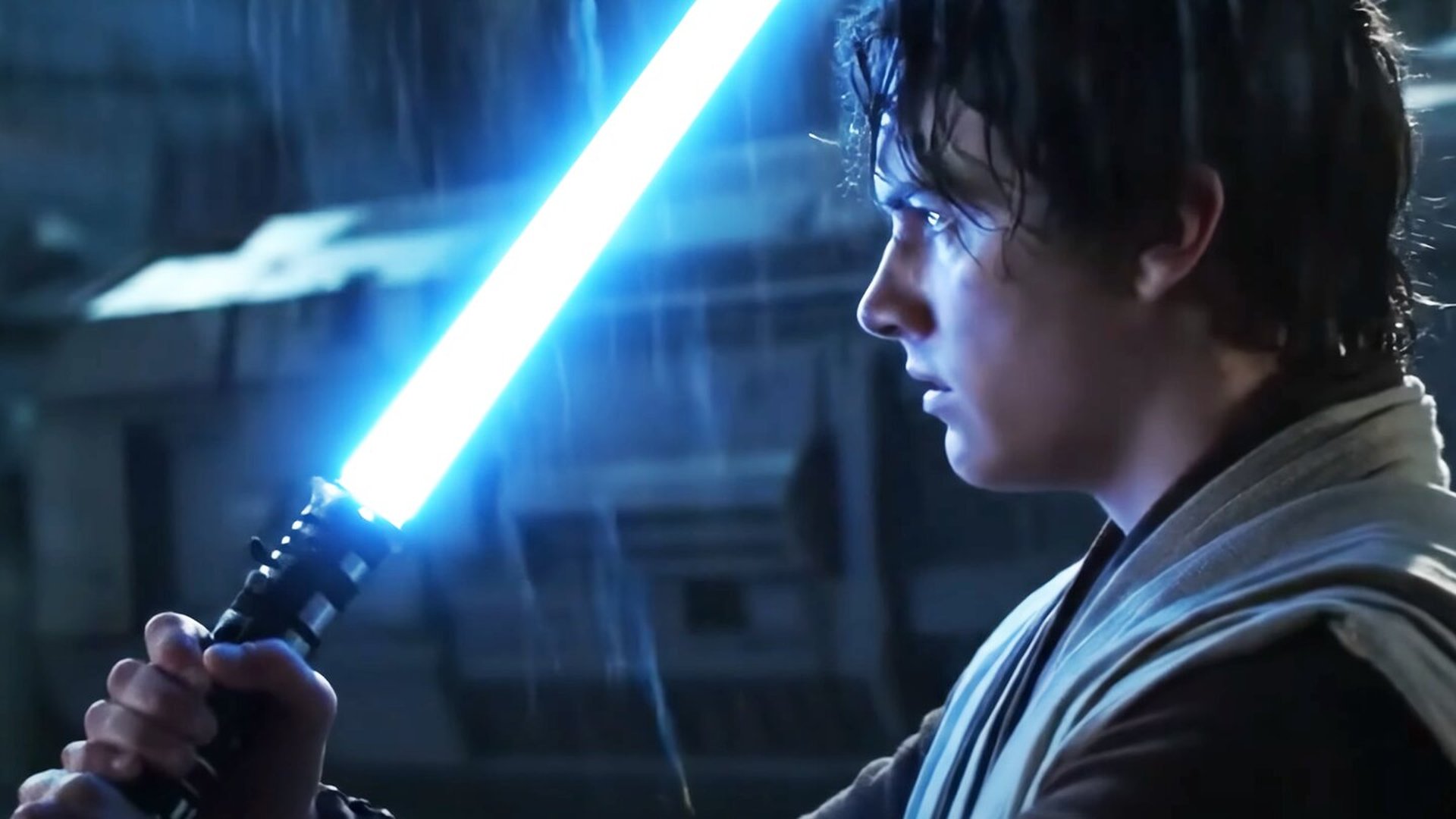
I watched 'Star Wars: The Ghost's Apprentice' in February, mostly to confirm it was bad. It is eleven minutes long. A guy who goes by Kavan the Kid made it in fourteen days, alone, on off-the-shelf tools: Veo, Midjourney, and Runway. Forbes wrote about him. The plot would not survive a workshop: a young Jedi a century after Luke Skywalker, trained by his uncle's Force Ghost, facing the rising High Imperium. The lightsaber blocking is mostly stiff. The score is the orchestral pastiche you've heard four hundred times.
I wanted to roll my eyes and close the tab.
I sat through the whole thing, watched it again, then sat there for a while. Partly because the duel near the end was, and this is the part I have stopped trying to talk myself out of, good. Not film-school good. Good in the way that makes you stop and reconsider what one person with consumer software can build now. Five years ago, nothing this person could have produced in two weeks would have looked like anything. The competence floor has been rising at a rate that should be making more people uncomfortable than it currently is.
So here is the argument. AI was always going to come for franchise pop culture first, because franchise pop culture spent the last twenty years optimising itself into a thing AI can trivially generate. The studios did not get blindsided. They built the pipeline. The shape of that pipeline, with its pattern repetition and audience testing and formulaic execution at industrial scale, happens to be the exact shape generative models excel at filling. Every battle currently being fought against AI in entertainment is real and worth fighting and mostly already lost, because the structural battle was conceded years before the technology arrived.
The 'Clair Obscur' problem
In April 2025, a French studio called Sandfall Interactive released a turn-based RPG called 'Clair Obscur: Expedition 33'. It became one of the games of the year. By December it had won nine trophies at the Game Awards, more than any title in the show's history, beating the seven-trophy record held by 'The Last of Us Part 2' since 2020. Then someone on X noticed that the wall-clipping textures on certain interiors looked AI-generated. They were. Producer François Meurisse had told the Spanish daily El País in July that the studio used "some AI, but not much." The textures were placeholder art for missed assets, patched out within five days of launch. Director Guillaume Brioche later clarified that the team had tried gen AI when it appeared in 2022, hadn't liked the feel, and hadn't used it for any of the actual art or voice work. The Indie Game Awards revoked the game's Game of the Year title in December. 'Blue Prince', by a solo developer called Dogubomb, got the trophy.

This was treated, in some quarters, as a victory.
Steam games openly using generative AI earned $660 million across 2025, including 'Call of Duty: Black Ops 6' and 'Stellaris'. 'Battlefield 6' was caught using AI assets that year. So was 'Call of Duty: Black Ops 7'. 'The Brutalist' used AI to perfect its lead actors' Hungarian accents and got nominated for Best Picture anyway. The pattern is consistent. A small piece of generative AI in the pipeline, public outcry, nothing happens to the commercial performance.
The 'Clair Obscur' disqualification is real, and the audience win is also real. It is also the high-water mark for audience resistance to AI in games, and it cost a small French studio an indie award it had already won. The games actually built on AI, the ones where it does load-bearing work, are mostly fine. Selection effects are doing most of the work. Sandfall got punished because 'Clair Obscur' was good enough to be visible. Most of the rest of the industry is laundering its AI usage through games people don't pay close enough attention to.
The Vader contract
In September 2024, James Earl Jones died. Before he died, he had authorised Lucasfilm to use AI tools to recreate his voice as Darth Vader for future Star Wars projects. In May 2025, Epic Games' 'Fortnite' added an AI Vader voice, playable and conversational and generated in real time. SAG-AFTRA filed an unfair labour practice charge against Llama Productions, Epic's signatory subsidiary, the same month. The union's argument was that the studio had replaced a performer with AI without bargaining, and that doing so to a deceased actor specifically deprived living voice actors of work. Vader impressionists exist. They are employable. The gig should have been theirs.

The legal architecture is quietly absurd. Jones, while alive, signed away the rights to his own posthumous voice. The estate consented. The studio used the consented-to AI replica in a video game. A living union filed an unfair-labour-practice charge with the NLRB, arguing that a dead member's replica had taken work from living members. The whole thing only makes sense once you accept that an actor's voice is now a separable asset from the actor, and that the asset persists independently of the body. That is no longer a science fiction premise. That is contract law.
The 2023 SAG-AFTRA strike ran 118 days, the first actors' strike since 1980, and ended on 9 November 2023. Members ratified the contract on 5 December; it introduced two new categories: Employment-Based Digital Replica and Independently Created Digital Replica. The Interactive Media Agreement followed in July 2025, after a separate, nearly year-long video game strike. Under the new IMA, game producers can generate a digital voice replica by prompting an AI model with the performer's name, provided the performer consents in writing, the consent is reasonably specific, and the studio pays compensation calculated by line at ten words per line. They have to deliver a usage report within ninety days of release.
What the union won here was real. Consent, compensation, and the principle that voice and likeness are bargainable assets. None of those existed five years ago, and the protections will materially improve a lot of working actors' lives.
What the union did not win, because no union could have, is the right to be the default. The default is now AI-generated, with human consent paid for at line-rate. Acting at the bottom of the industry, where background work and dubbing and side-character VO live, is going to be a place humans visit rather than a place humans live, within a decade. The shift is in the contract itself, written down and ratified.
The Norwood backlash
In September 2025, a Dutch producer named Eline Van der Velden announced at the Zurich Summit that her London-based AI division, Xicoia, had created a digital actress called Tilly Norwood, and that Hollywood agencies were interested in signing her. Deadline ran the headline "Talent Agents Circle AI Actress Tilly Norwood." The reaction was loud. Emily Blunt called it "really, really scary." Whoopi Goldberg said it was an unfair advantage. Mara Wilson asked why none of the hundreds of real women whose faces had been composited together to make Norwood could have been hired instead. A Scottish actress called Briony Monroe announced she was consulting Equity, on the grounds that she believed Norwood had been modelled on her face and mannerisms. WME and the Gersh Agency both publicly refused representation. SAG-AFTRA issued a statement calling Norwood "a character generated by a computer program that was trained on the work of countless professional performers, without permission or compensation."

In October, Kevin O'Leary went on television and proposed replacing background actors with, in his exact words, "100 Norwell Tillies." He could not pronounce the name of the AI actress he was advocating for. This is the level of seriousness AI in entertainment is sometimes operating at.
On first read the story is one of backlash. Hollywood saw the AI actress, recoiled, and shut it down. Within a month, Van der Velden had walked back the agency claim. By April 2026, Marie Claire was running a piece titled "Is Tilly Norwood the Most Dangerous 'Actress' in Hollywood?" that conceded, in passing, that "audiences have not been kind to AI-led productions."
Meanwhile, in November 2025, Van der Velden had quietly announced she was creating forty more "very diverse" AI characters to round out Norwood's universe. The obvious temptation is to model some closely enough on real performers to feel familiar, but diffusely enough to make ownership hard to prove. They may appear in productions that don't market themselves as AI-led. Most will fail. A few may not. The win condition is filling the third tier of streaming-platform programming where nobody is looking closely enough to notice. Scarlett Johansson was never the target. That tier is enormous. Netflix puts out around seven hundred original titles a year. Disney+ keeps the lights on with three-hour cuts of theme-park ride lore. The audience for visible Hollywood is paying attention. The audience for the ambient slurry of streaming content is, by definition, not.
Why franchises were ready
Each of these stories ('Clair Obscur', the Vader contract, the Norwood announcement) gets covered as a fresh battle in the fight over AI's role in entertainment. None of them are. The battle is over. The studios won it in slow motion, against themselves, by spending two decades turning film and games into a franchise-extension business that pre-supposed pattern execution as the core unit of value.
Consider what a franchise sequel actually is, structurally. A project with fixed audience expectations, an established visual grammar, and a development cycle optimised to deliver the next iteration at minimum surprise. Marvel Studios at its peak was running this cycle with the discipline of a software company shipping minor releases. The 2026 theatrical release 'Mandalorian and Grogu' is itself a feature-length sequel to a streaming series set five years after a film from 1983. The reason AI-generated content sounds plausibly competent in this context is that the content was already being generated by humans operating under constraints not meaningfully different from a model's. Marvel writers' rooms have been compared to procedural-generation systems by Marvel writers themselves. The system that produces 'Hawkeye' Season 2 is closer in shape to a language model than to a writers' room from twenty years ago.
This is the part I think gets missed in most AI-and-entertainment coverage. The technology did not disrupt the entertainment industry. The entertainment industry had spent twenty years reshaping itself into a thing the technology could naturally inhabit. 'Andor' exists because one writer with a thesis was given the runway to make it. Almost nothing else in the current Star Wars catalogue has that property. Almost nothing in the current Marvel catalogue does. The industry trained its own labour force to write like AI for a decade, and now actual AI is here, and of course it slots in cleanly.
What's coming
Back to Kavan the Kid.
The interesting thing about 'Ghost's Apprentice' isn't that it exists. Fan films have existed since the camcorder, and the Star Wars fan-film community has been making them for thirty years. What's new is that the gap between fan-made and studio-made has, for the first time, gotten visibly small. Eleven minutes long, two weeks to make, mainstream press coverage. Now extrapolate.

In 2027 or thereabouts, somebody who hated the sequel trilogy will produce a two-hour AI-generated alternate Episode VII, and a non-trivial number of Star Wars fans will say, sincerely, that they prefer it to 'The Force Awakens'. The film will be illegal. Disney will sue. The fan will lose. Four more fans will do it. Forty after that. The takedown machine will fail the way it failed lyric sites in 2002 and the early MP3 networks in 1999. Disney will spend two years issuing notices, and then announce a licensing programme allowing fans to produce derivative AI Star Wars content for personal use, with a revenue share when something goes viral. The programme will be called something dignified like Studio Forge. It will be staffed by people who, in 2025, were drafting the lawsuits.
The reason I'm certain about the shape of this is that the playbook is already public. Napster got sued, Spotify got built. YouTube got sued in 2007 and licensed by 2010. Disney sued Midjourney in June 2025 for unauthorised recreations of Bart Simpson and Wall-E. Disney announced an integration with OpenAI's Sora 2 in May 2026. Same studio, not even a year apart. The lawsuits and the licensing operate in sequence, not in tension.
Where this lands the actual film-going experience is harder to predict. The optimistic version is that franchise pop culture splits cleanly in two. There is the human, expensive, prestige tier (the next 'Andor', the next thing made by somebody with something to say) and there is the ambient AI-generated tier of side spinoffs and streaming filler. Fans make their own canon. Studios sell the official canon at higher prices. Real actors work in the prestige tier and get paid better than they are now. Voice actors mostly do not.
The pessimistic version is that the line does not hold. That the prestige tier shrinks year over year because every studio has a CFO who can read a Sora demo, and what's coming for indie filmmaking and indie game development is a global flood of cheap, narratively coherent content that's good enough to fill the time slot and the streaming queue. The competition for human attention gets fiercer not because AI content is better, but because there is so much more of it.
I don't know which version arrives. I suspect a mix, with the proportions worse in the United States than in Europe, because Europe has a regulatory tradition that does occasionally produce real constraints (the AI Act, the DMA, the GDPR before them) and a public-broadcasting infrastructure that already values being-good-on-purpose over engaging-at-scale. Arte will not be using Sora for its evening film slot. NRK will not be replacing Skam's writers with a language model. Some of this matters.
I should have closed the laptop. I didn't. Instead I scrolled to the comments under 'Ghost's Apprentice'. One of the comments said: "better than anything Disney has done in years." Below it, somebody had typed: "please remake the whole sequel trilogy." Both replies were posted by people who would, under any reasonable definition, count as the audience the studios are spending billions to retain.