On the evening of May 20, 2026, Amazon released the series finale of 'The Boys' after five seasons. The next morning, Elon Musk called the ending "pathetic." Within two days he had also clarified, on his own social media platform, that he had not in fact watched the show. The showrunner, by his account, had written the conclusion under pressure from his wife's boyfriend. The ending, he added, "sounded fake and gay."
What Musk did not address, then or in any of the follow-ups, was the cameo earlier in episode eight that introduces Günter Van Ellis, billed in the show as "the world's richest man," a self-described "disruptor" with seventeen children and an amateur astronaut habit, who arrives at the White House to lobby Homelander about white fertility rates while wearing an all-black "We Believe in Homelander" cap visually identical to the dark MAGA hat Musk wore during his real-life White House tour. The character is so transparently Musk that Eric Kripke, the showrunner, did not need to confirm it on the record. Musk's response to a satire of himself was to confirm it in real time: posting a one-word insult beneath a fictional version of his own behaviour, then continuing to post for the next two days.
Here is the cultural ground at the moment: the richest man on earth, his power untouched and his platform purchased, calls a TV show "fake and gay" because the show implied that a friend of his has the emotional range of a toddler with a god complex. The complaint, as always, is "woke." It is always "woke." The word has, by this point, travelled so far from the place where it began that you could plot the line and use it to forecast the price of the dollar.
Worth saying what the word actually meant, before it became the cultural equivalent of a child's lunchbox sticker. "Woke" comes from African American Vernacular English. Its earliest documented printed appearance is from 1924, in the Houston Informer, where the phrase is introduced to readers as new Black street slang meaning to stay alert at one's post of duty. In 1938, the blues musician Huddie Ledbetter — Lead Belly — used "stay woke" in a spoken afterword to his song about the Scottsboro Boys, the nine Black teenagers falsely accused in 1931 of raping two white women on an Alabama train. The Smithsonian holds the recording. Lead Belly's instruction was operational: when you travel through Alabama, you keep your eyes open, because the state will kill you if you don't. The 1962 New York Times piece by the novelist William Melvin Kelley, titled 'If You're Woke You Dig It', carried the word into wider mainstream print as a marker of cultural and political consciousness in Black America. Erykah Badu used the phrase "I stay woke" in her 2008 track 'Master Teacher'. After the Ferguson police shot Michael Brown dead in 2014, "stay woke" became the operative shorthand of the Black Lives Matter movement.
That is the word. A century of Black Americans telling other Black Americans not to get killed.

Every time Elon Musk types "woke mind virus" — his standard sneer for his estranged daughter, for any film he hasn't watched, for the show whose finale just showed his favourite supervillain begging on his knees — he is wearing the ghost of Huddie Ledbetter as a costume. He almost certainly does not know it. That isn't an excuse.
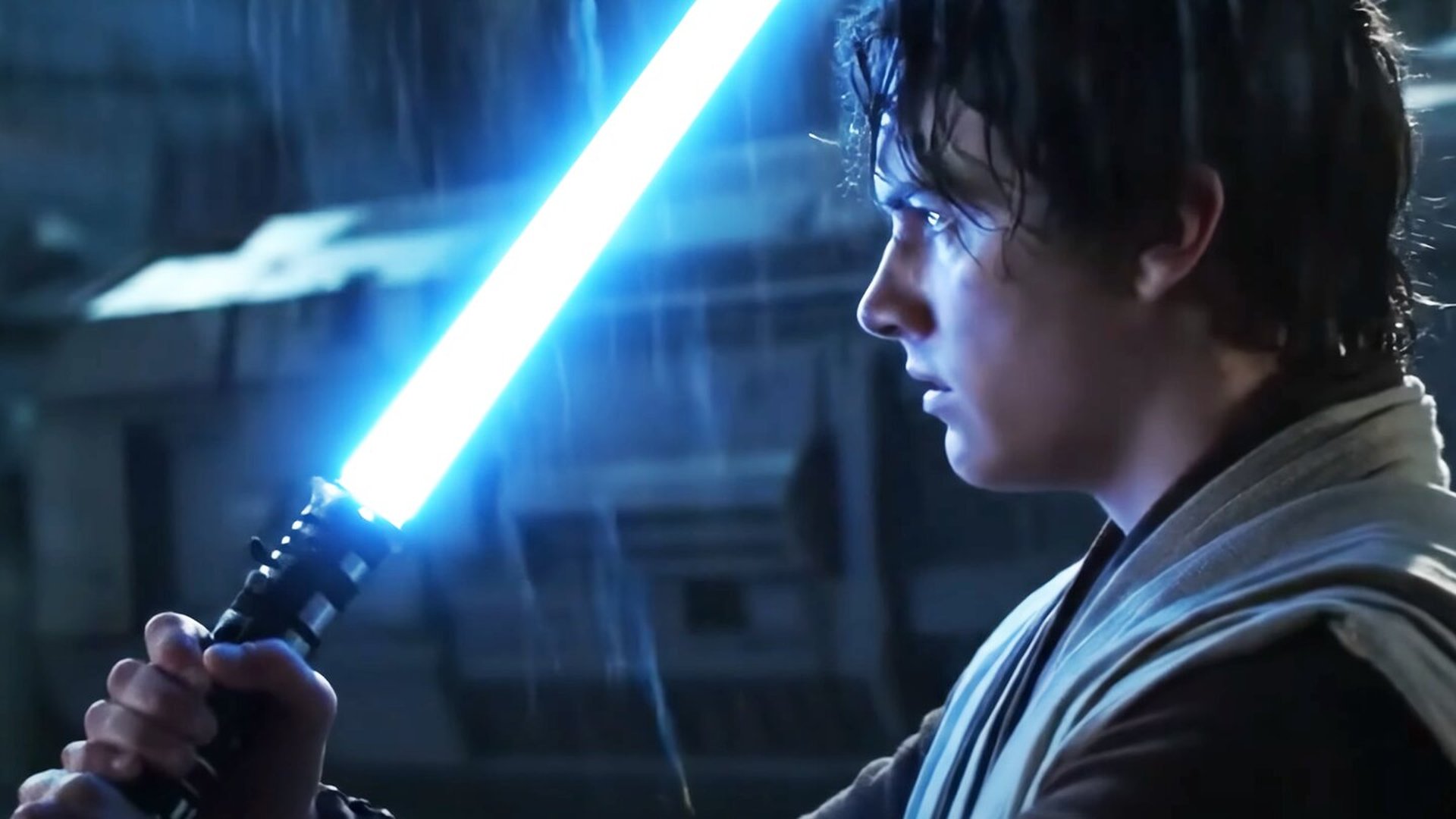
The pop culture industry of "anti-wokeness" has a birthday. It is December 2015, the month 'The Force Awakens' was released. Within a week of the film's premiere, the screenwriter Max Landis tweeted that Rey was a "Mary Sue" — a too-competent female character who exists, in this argument, only because the filmmakers wanted to please women. A YouTube ecosystem assembled around the complaint with the speed of a bacterial colony. Channels that had previously made videos about 'Halo' lore began making forty-minute videos about why Rey shouldn't be allowed to fly the Millennium Falcon. By the time 'The Last Jedi' arrived in 2017, the apparatus was operational. The actress Kelly Marie Tran was harassed off Instagram by people who had decided her character was an attack on Star Wars itself. She was twenty-eight years old.
The vocabulary mutated. It had done this before. "SJW" (short for Social Justice Warrior) had circulated in online discourse from roughly 2011 onward as a descriptive label for people advocating online for marginalised groups. Within two or three years, the same online reactionaries who would later weaponise "woke" had inverted it through sustained sarcastic use, until a word that originally signalled commitment to fairness now meant naive and performative. The mechanism is not subtle. Say a term often enough in a mocking tone, and the connotation flips. By the time the anti-SJW YouTube economy had fully assembled, the people the word once described had quietly stopped using it. "Woke" was the next vocabulary up.
The targets stayed identical to what they always were — anyone in a leading role who wasn't a straight white man, plus whichever subplot had been added to make a franchise less of a private clubhouse. The complaint sounded sophisticated when read aloud in a Scottish accent by a man called The Critical Drinker. On the page, it was always the same: this art used to be only for me, and now it isn't only for me, and that has made me unhappy.
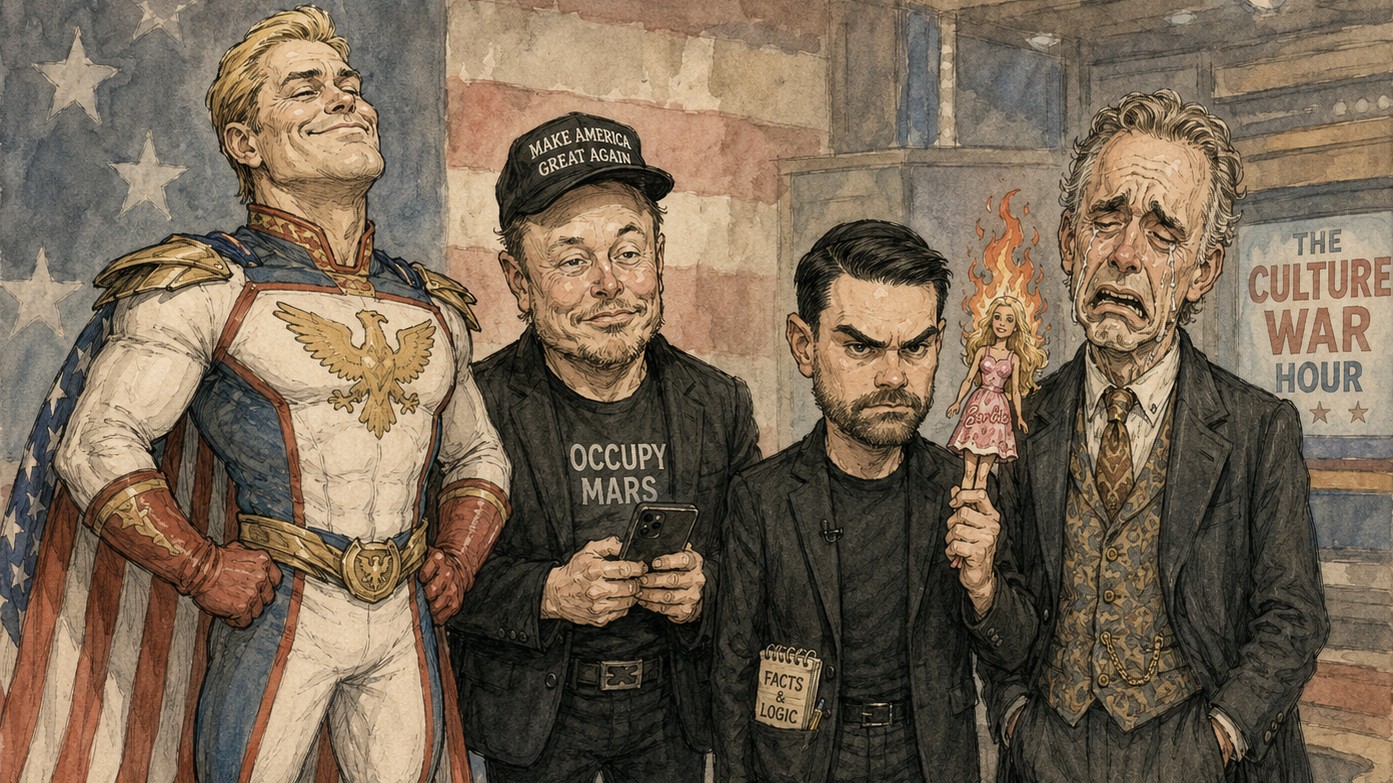
The grift monetised within twenty-four months. Ben Shapiro, paid by the Daily Wire to be wrong about culture, identified the addressable market and pivoted in. So did Jordan Peterson, who had built a global brand selling young men the idea that they were unhappy and needed a steady supply of cultural enemies to point at. So did Matt Walsh, Candace Owens, and a long tail of names you'd recognise from a Joe Rogan guest list. The business model is the same on every channel. Take a piece of pop culture. Declare it "woke." Sell the audience the explanation they already wanted.
The receipts on this grift are public record, and they should be re-read often.
In July 2023, Ben Shapiro published a forty-three-minute YouTube review of 'Barbie'. He opened it with footage of himself purchasing Barbie and Ken dolls at retail, then setting them on fire in a metal bin on camera. The dolls had been bought, at full price, from Mattel. Mattel kept the money. Over the following forty-three minutes, Shapiro waved a notebook of handwritten pages of notes at the camera. He branded the film "flaming garbage." On the record, he predicted that 'Barbie' would collapse at the box office, with no repeat business worth mentioning. 'Barbie' went on to gross $1.45 billion worldwide. It is the highest-grossing film in the history of Warner Bros. Greta Gerwig is now one of the most powerful directors in Hollywood. Shapiro is still making forty-three-minute YouTube videos for the same audience.
In 2022, Jordan Peterson was suspended from Twitter for deadnaming the actor Elliot Page. He returned with the line "Up yours, woke moralists! We'll see who cancels who!" — a sentence so theatrically unhinged that the internet remixed it into clips from 'Command & Conquer: Red Alert 3' alongside Tim Curry's villain monologue and could not, on first listen, tell them apart. In 2023, Peterson retweeted a Babylon Bee piece headlined "Disney to remove problematic kiss from classic movie, Snow White will now remain dead," with a caption suggesting Disney could not stop chasing failure. The Babylon Bee is a satire site; it exists to produce satire of progressive media. Peterson did not, at first scan, distinguish the satire from real news, because both fit the shape of his grievance. The retweet is still on his timeline.
Elon Musk, the third musketeer, has spent the past three years using "woke" as the principal organising verb of his political identity. He sells the word. He pays for it. His acquisition of a social media platform was partly a strategy for being able to keep saying it without consequence. His latest cultural intervention, the one this essay opened with, was to type a one-word insult beneath a piece of fiction that humiliates a fictional version of him, then keep typing for two more days.
This is what the grift produces. The same six men, between them worth somewhere north of a hundred billion dollars, posting like overgrown forum moderators about a TV show whose central thesis is that men like them are dangerous.
A fair-minded reader will raise the obvious counter. Sometimes the films the anti-woke crowd targets do flop. 'Snow White' lost Disney around $170 million in 2025. 'The Marvels' lost more. 'The Acolyte' was cancelled after a single season. Doesn't that prove something?
It proves that some films are bad, and that bad films lose money. The live-action 'Snow White' had a 39 on Rotten Tomatoes and a 50 on Metacritic. Rachel Zegler, talented enough to lead the next decade of Hollywood musicals if anyone had built the project around her competently, gave press interviews that the studio was hilariously unprepared for. The film's seven dwarves became "magical creatures," then became digital dwarves again, in a public relations sequence so embarrassing that even Peter Dinklage — who had originally raised the question of whether the story should be remade at all — ended up sounding like the calm adult in the room. The film failed because Disney made a bad film.
What the "woke" critique cannot account for is the other half of the ledger. 'Lilo & Stitch', the 2025 live-action remake about a Hawaiian girl and her alien dog, made over $1 billion worldwide. 'Inside Out 2', with a teenage girl protagonist navigating anxiety and ennui, is the highest-grossing animated film in history at $1.7 billion. 'Wakanda Forever' cleared $859 million. 'Moana 2' hit a billion in its first month. 'Deadpool & Wolverine', a film whose comedy is so explicitly anti-reactionary that Ryan Reynolds spends half of it making jokes that would get him cancelled by his own audience if he delivered them as monologues, took $1.3 billion. The receipts get cherry-picked. They always do.
The deeper problem is that the grift is structurally incapable of evaluating art. Its categories are pre-decided. A film with a female lead is already woke; a film with a male lead is judged on the merits. A franchise dies because of progressive casting, and the same franchise survives in spite of progressive casting, and the framework producing both verdicts is the same framework. None of this is analysis.
The reason the anti-woke economy is finally wheezing is that the audience for grievance is finite. The Critical Drinker still pulls 2.4 million subscribers, but the through-line is fraying. The Quartering has spent two years claiming YouTube is suppressing his channel, which is the kind of complaint a content creator makes when the simpler explanation — that people got bored — has stopped being survivable. The Daily Wire spent real money producing its own remake of 'Snow White', starring Brett Cooper, and approximately nobody watched it. Peterson now writes tweets formatted as poems and is reviewed in Rolling Stone by actual poets. The grift's apex predators are ageing into self-parody at roughly the rate the satire of them is sharpening.
'The Boys' finale is, in its way, the death certificate. The show was built eight years ago as a critique of Trump-era authoritarianism dressed up as superhero parody, and it landed in May 2026 with Homelander on his knees, powerless, begging Billy Butcher for mercy and receiving none. The episode's clearest tell is that the writers, having made this show specifically about the men Musk has spent his fortune empowering, included a Musk parody by name, gave him seventeen children and a fertility-rate monologue, dressed him in a black "We Believe in Homelander" hat, and then watched the actual Musk respond on the actual platform he owns by calling the ending "pathetic" without once acknowledging the parody. There is no satirical move sharper than the target writing your follow-up.
I watched the finale on the Wednesday it dropped. The Disruptor cameo lands in the middle of a White House scene; blink and you miss it. I didn't blink.
By Thursday afternoon, Musk had tweeted "pathetic" beneath someone else's post about the ending. He has not, at the time of writing, mentioned the Disruptor scene once.
The show was about him. About all of them. They still haven't noticed.