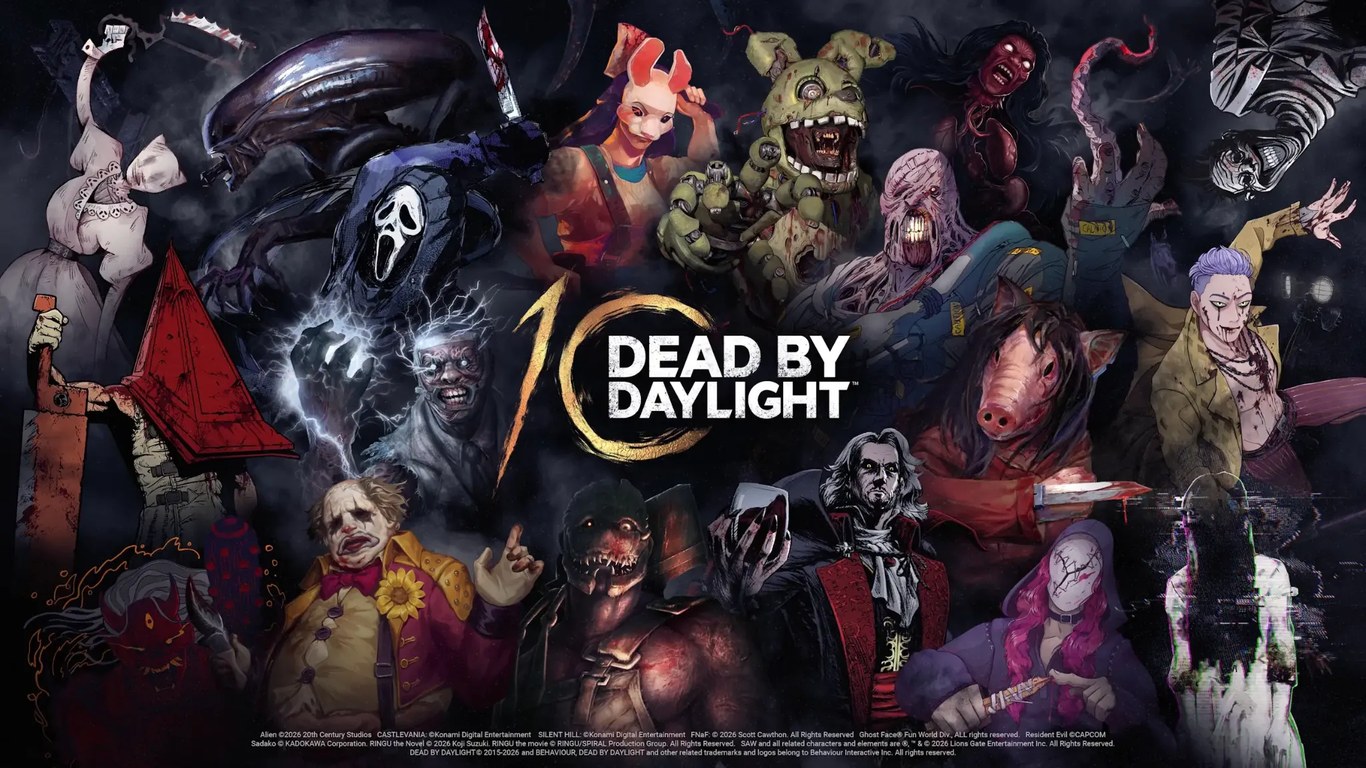
On Sunday, three thousand people paid to stand in a port building in Montreal and throw a birthday party for a video game about fixing generators. There was a cosplay parade and, because every birthday needs one now, a vinyl pressing of the soundtrack. The game's called 'Dead by Daylight', it turned ten that day, and the thing getting the gallery treatment is a match where four people repair fuse boxes in the dark while a fifth jogs around trying to hang them on hooks.
I meant to write this off as fan-convention silliness and couldn't, because the numbers behind it are the most interesting thing in games this month. The game's past seventy million players and bigger now than it's ever been, and it got there during the worst eighteen months this kind of game has ever had. That's the part worth slowing down for.
The going theory in 2026 is that the live-service game, the one you're meant to play forever and feed every month, is finished. Four years after buying Bungie to lead exactly this charge, Sony wrote the best part of eight hundred million dollars off the studio this May, after 'Marathon' launched in March and sold far short of the plan and 'Destiny 2' kept thinning out. 'Concord', Sony's try before that, lasted a fortnight in 2024. Electronic Arts shipped the best-selling game in America and then cut jobs at the Stockholm studio that built it. Everyone drew the same moral: the audience had walked off.
'Dead by Daylight' is the standing argument that the moral's lazy. It isn't that nobody wants a game to play for years. It's that the one nobody wanted was the expensive one, the forever-game built on a blockbuster's budget and ordered to earn it back by the second weekend. Behaviour Interactive did the opposite, mostly because it couldn't afford anything else.
Behaviour spent its first quarter-century in Montreal making other people's games, the contract work and licensed tie-ins nobody remembers playing. 'Dead by Daylight' was its own small bet, a four-on-one horror match with no famous name on the box, and it first slipped into the world not through some Hollywood publisher but through Starbreeze, the Stockholm outfit you might know from 'Payday'. Behaviour bought the rights back off them for sixteen million dollars in 2018, which is starting to look like the steal of the decade.
The clever part came next. Instead of building a horror universe and praying anyone cared, the game just rented all of them at once. Michael Myers and Freddy Krueger you could have guessed. After that it stops making any sense: Pyramid Head out of 'Silent Hill', Pinhead on loan from Clive Barker's 'Hellraiser', the Xenomorph from 'Alien', and, sold separately, Nicolas Cage, playing himself. These days it barely has characters of its own; it's a venue, the one room where every monster in horror has to share a lobby. You can't design that. You can only stay open long enough that the rights-holders start coming to you.
That's how, tomorrow, Jason Voorhees walks in. He hasn't been playable in anything since the official 'Friday the 13th' game switched its servers off at the end of 2024, killed by a rights dispute, and the most recognisable slasher in horror has spent the eighteen months since with nowhere to haunt. Now he turns up in a ten-year-old Canadian game because it's the last house on the street with the lights still on.

None of this is charity. The birthday came wrapped in a merch drop and a rack of cosmetic bundles priced like small kitchen appliances, and “rent the monster” is a business model long before it's a love letter. Still, durability buys a bit of grace. A game that's lasted ten years, still growing, having outlived the things built to bury it, has earned a sentence its richer rivals never will.
It lived by staying cheap enough that nobody ever had to save it. Tomorrow a man in a hockey mask, evicted from his own franchise, clocks in.