I bought a Steam Deck on the morning it went on sale, the 25th of February 2022, and then I bought the OLED the morning that went on sale too, the 16th of November 2023, so we can dispense with any pretence that I am a neutral party here. I am the easy mark, the man Valve sketches on a whiteboard when it needs cheering up. Whatever Gabe is selling, historically, I have queued for it in the cold.
For most of my adult life I was a console person, and contentedly so. A box went under the telly, a disc went into the box, and at no point was I troubled by the question of what a shader is or why mine seemed to be the wrong sort. Then the Deck got its hooks in. It turned up pretending to be a console, revealed itself to be a full-fat PC the first time I poked at it, and inside a fortnight I was up past midnight wrangling Proton compatibility layers and per-game wattage limits like a man who had found religion in a settings menu. I have not recovered. I am a PC gamer now, for good, and I fully expect to be buried with a microSD card somewhere about my person so I have something to load on the way down. Valve and SteamOS did this to me. They have had an indecent sum of money out of me, and one entire weekend in March 2022 that I am never getting back.
Which is the only reason to take what follows seriously, because it is coming from inside the cult.
The Steam Machine starts at 1,049 dollars, or 879 pounds, and for that you get the 512GB box and no controller, Valve having decided to sell you a living-room games machine while leaving the actual playing of games as a separate transaction. Tick the boxes for 2TB and the new Steam Controller and you are up at 1,428 dollars. The full spec sheet is sitting on Steam if you want it, though the spec was never going to be the story. The kindest reading of the controller-free base model is that Valve assumes anyone in the market for this already owns three pads and a shoebox of cables, which, as it happens, describes me down to the ground.
The number that actually matters is the one Valve would rather you did not sit with for too long. The price it set out to charge was somewhere around 750 dollars. So the gap between the machine Valve meant to build and the machine you can buy on Tuesday is roughly three hundred dollars, and not one cent of that three hundred went anywhere near the machine. It went into a bidding war nobody told you that you had entered, against a class of buyer who will never run a single frame of a single game on the silicon they are carting off by the lorry-load.

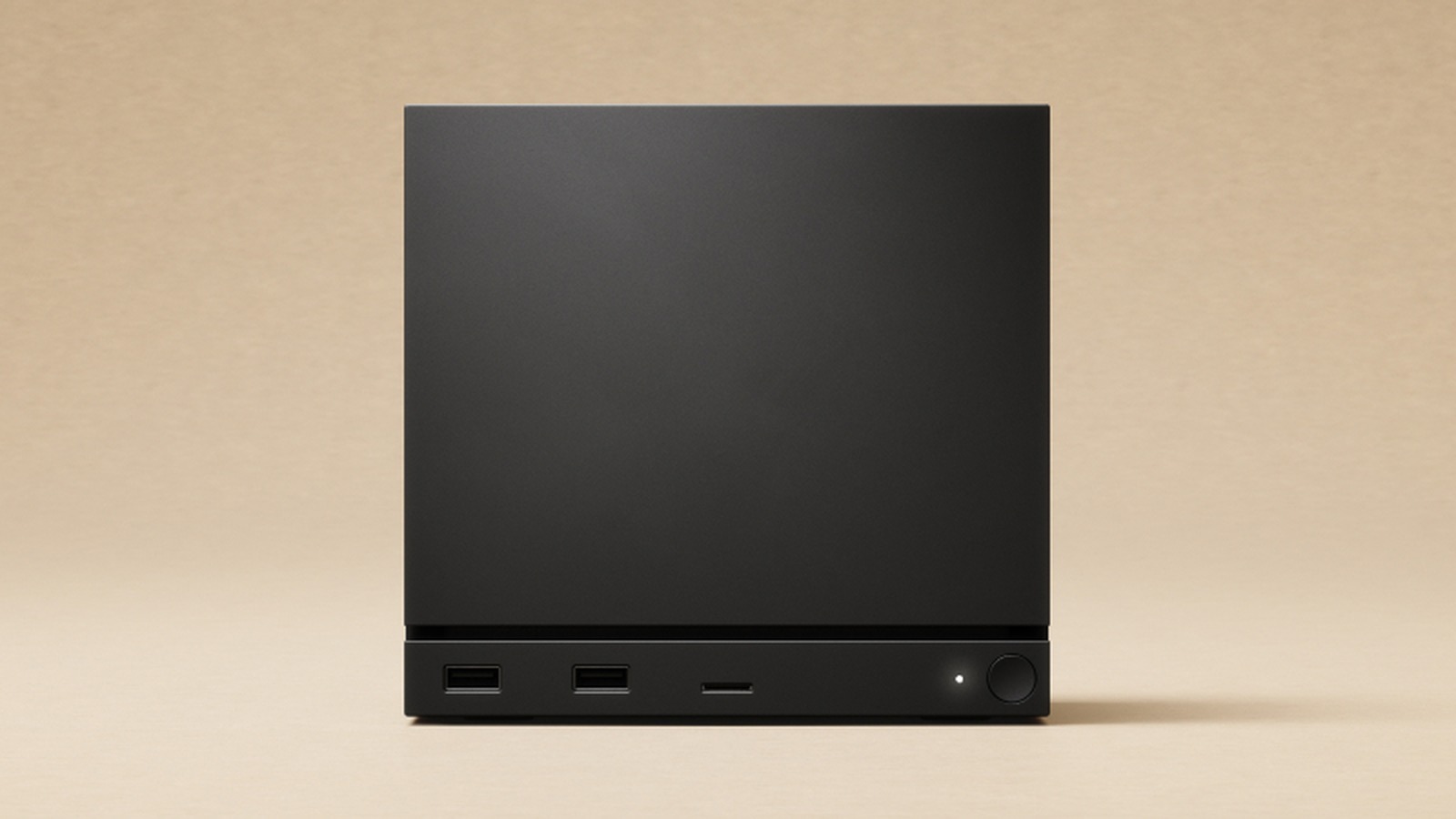
Physically the Steam Machine is a six-inch cube, and once you have set aside the heatsink and the power supply, what is left inside is mostly the two components that have come loose from reality this year: memory and storage. Keep hold of that, because it is the whole story wearing a hardware review as a disguise.
The three companies that make most of the world's memory, Samsung and SK Hynix and Micron, spent this year swinging their factories away from the kind of memory that goes in your computer and towards the kind that goes in an AI accelerator, on the straightforward logic that the second kind sells for far more and its buyers sign contracts that lock up years of supply in one go. Contract prices for ordinary DRAM jumped by something close to ninety per cent in the first quarter of 2026 alone, a leap that IEEE Spectrum and IDC both clocked as the steepest in living memory. The arithmetic underneath it is as brutal as it is tidy: one gigabyte of the high-bandwidth stuff the accelerators crave eats roughly four gigabytes' worth of the factory time that used to make the ordinary stuff. Micron went as far as shutting down Crucial, the brand it had spent years selling sticks of RAM to people like us under, and Apple pulled several of its higher-memory Macs from sale because it could no longer get the parts at a price that made sense to anybody. When a company the size of Apple cannot lay hands on RAM at a sane price, the small Linux cube in your shopping basket was never going to be spared.
That is the weather the Steam Machine walked out into, and it is worth being precise about whose doing that is, which is to say not Valve's. This was an entire industry turning, all at once, to face the money.
So when Valve says the price reflects "the state of the world for manufacturing", I take it at its word, and its engineer Pierre-Loup Griffais said the same thing in plainer clothes: the box was costed against memory prices from two years ago, and the floor gave way beneath it while it was being built. I believe all of it, and it changes precisely nothing about whether you should buy one.
Set against what else a grand will buy you, the hardware lands in a rough part of town. A base PlayStation 5 goes for roughly half the money and outruns the cube across a fair spread of games. And when Gamers Nexus put together a like-for-like PC out of shop parts, it came to around 979 dollars, some seventy under the cheapest Steam Machine, and the home build ran faster on top of that, because Valve has throttled its cube hard to keep it small and quiet, thirty watts to the processor and a hundred and ten to the graphics. So the cube costs more than a console that beats it and more than a tower that beats it by a wider margin, which is quite the spot to have landed in. The 512GB model, while we are here, holds about two modern games before it starts giving you a meaningful look and you are back on the storefront paying for a memory card.
None of which is a scandal, exactly. A seven per cent premium over a PC you would otherwise have to build yourself, for a thing that switches on like a kettle and never once asks you to think the word Linux, is in an ordinary year a perfectly sensible trade. The catch is that this is not an ordinary year, so the premium is fine and the price it is perched on top of is the problem, and that price was settled in a room Valve was not allowed into.
I keep circling back to the counterfactual, because it is the part that stings. At 750 dollars, on a shelf in the summer of 2025, this is a machine I would have queued for at nine in the morning with a coffee going cold beside me, exactly as I did for both Decks. And that machine exists, sitting fully designed on a hard drive in Bellevue, ready to go. It simply had the bad luck to arrive in a year that had stopped making sense for anyone who is not a hyperscaler.
Will it sell? Of course it will, and that is the bleakest gag in the whole business. Supply is thin, the first wave is a lottery rather than a shop, and you had to already hold a Steam account in good standing with a purchase logged before late April just to put your name in the hat. So it sells out, the headlines file it under triumph, and the triumph turns out to be a story about scarcity dressed up as demand and hoping nobody checks under the costume. Companies do not walk a hardware price back down once it has been set, not unless they are bleeding, and Valve is conspicuously not bleeding. If memory ever comes back to its senses they might pass a little of it on, because by the dismal standards of this industry Valve is one of the few outfits that treats its customers like adults. I would not be planning my month around the might.
You could object, with some justice, that this is not all the chatbots' fault. Graphics cards have been daft money since the crypto-mining years, and a shortage of anything tends to have more than one parent. Granted, and yet the scale does not begin to compare: crypto was a nuisance that put one component briefly out of reach, whereas the AI build-out has gone and rewritten what the world's memory factories are for. At CES in January, somebody had the nerve to ask Jensen Huang whether gamers might end up resenting AI for what it has done to the price of their toys, and the man whose company is running the auction cheerfully assured the room that everyone in the supply chain was doing great. Which is the one thing he said all day that I cannot argue with.
The American write-ups keep skipping the connection that is most obvious from over here. We did the responsible thing. The EU produced an AI Act after two years of arguing itself hoarse over risk tiers and model cards, and felt rather grown-up about the whole affair. And the bill for all that compute still turns up on a shelf in a games shop in Stockholm, taped to a cube that would like 1,000 pounds for the honour of running 'Cyberpunk 2077' on my sofa. You cannot regulate your way out of an auction you were never invited to bid in. The buyer in the server hall in Virginia has not read one line of the Official Journal of the European Union, and he is not about to start now.
So I will be sitting this one out. The Steam Deck OLED I bought in 2023 now costs about forty per cent more than I paid for it, Valve having put its price up in late May for every reason set out above, which is a small sermon all of its own, and the thing still works a treat. The Steam Machine goes on sale on Tuesday morning, and on Tuesday morning I will be on a train into town with that same Deck in my bag and something loaded onto it the night before, playing it somewhere no data centre can reach me.