The first time I met the Turtles, somebody had already taken their weapons off them. In Germany the show wasn't called 'Teenage Mutant Ninja Turtles'. It was 'Teenage Mutant Hero Turtles', the same edited cut that ran across the UK, Austria and half the continent, because a cluster of broadcasters had decided the word ninja carried a body count. Michelangelo's nunchaku were gone, snipped out of the opening or swapped for a grappling hook the show called a Turtle Line. In that version, the theme song's "heroes in a half shell" sounded like a correction. I was in my early teens, and I loved a sanitised version of four characters who had started life as a black-and-white parody of a Frank Miller comic, and I did not know any of that, and it would not have changed a thing.
A few thousand words about cartoon turtles is, I'm told, not a serious use of a grown man's afternoon. This kind of objection has never once come from someone whose afternoons I envied, so I've stopped fielding it. If it's yours, no hard feelings, and the door's behind you.
It took me three decades to work out that I'm a fan of the Turtles as a concept, not as a run. Everything I have ever felt about this franchise comes out of that one distinction. The swing moves me. The marathon loses me. Give me one fresh angle, thrown by someone with something to say and finished before it outstays its welcome, and I'm yours. Ask me for a decade of faith across a hundred issues and I'm gone, somewhere between issue six and issue twenty, the moment the novelty burns off and a great thing settles into a competent one and keeps going.
You can read that as a flaw, but it's the taste itself, working as designed. "Give the slow burn a chance" is advice that fits other people, and fits me everywhere but here. The useful move is to stop arguing with it.
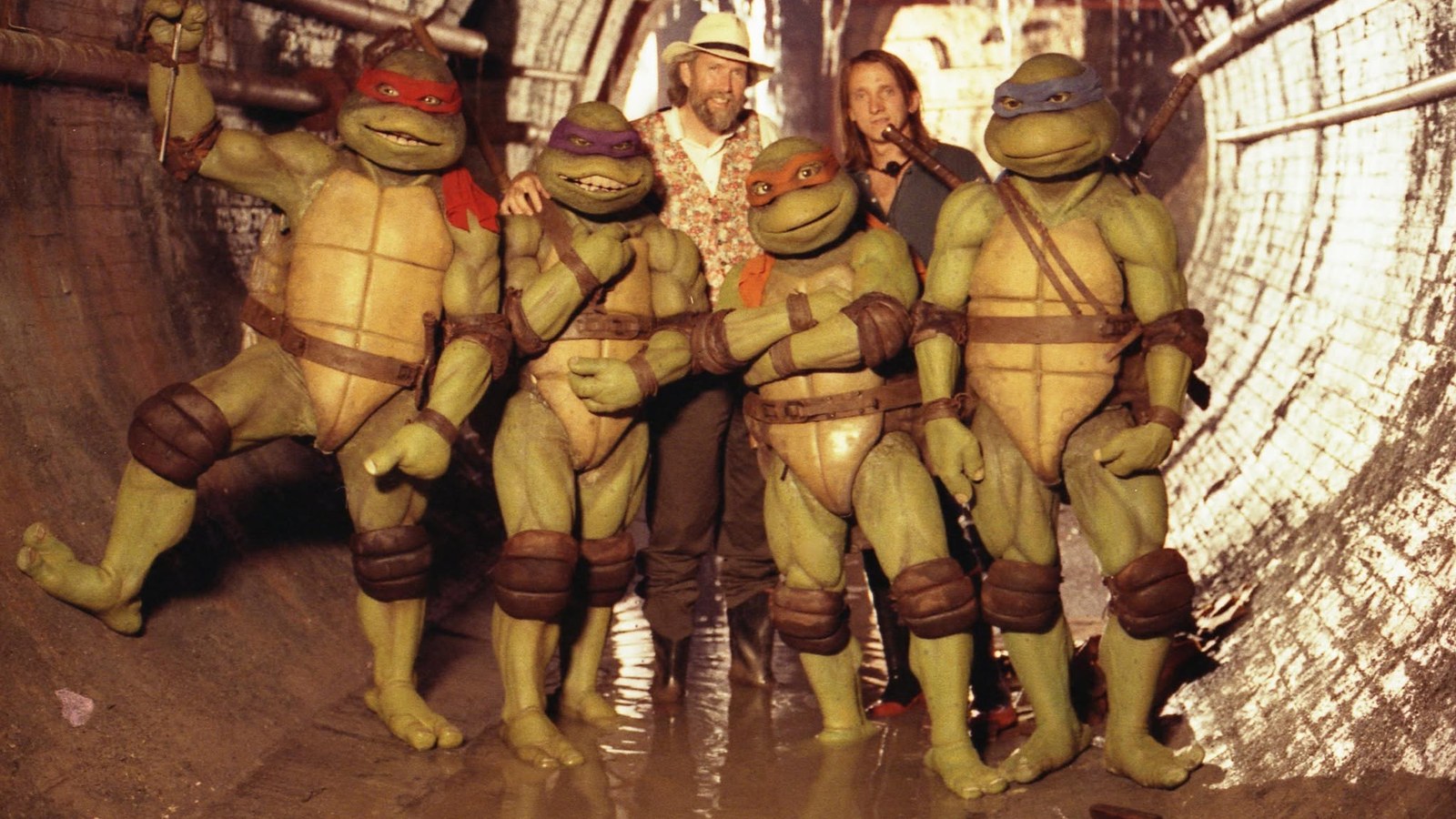
The 1990 film is the high point of the entire screen history, and the fandom is close to unanimous on this, which for a fandom is its own small miracle. The reason it works is structural, and it is literal rather than atmospheric. The money came from Golden Harvest, the Hong Kong studio behind Bruce Lee and Jackie Chan, after every major American studio passed: Disney, Columbia, Warner, and, with a flourish history would come to enjoy, Paramount, which now owns the brand outright and turned the original down flat. They were all afraid of another 'Masters of the Universe'. Distribution landed halfway through the shoot with New Line, then a scrappy genre house rather than the machine it became. The director was Steve Barron, a music-video man whose previous credits were 'Take On Me' and 'Billie Jean', which is to say he arrived with no franchise-pipeline instincts at all. And the suits came out of Jim Henson's Creature Shop in London, tactile and a shade imperfect in a way that carries weight, the last work Henson signed off on before he died, weeks after the film opened.
Underneath the pizza jokes the film is carrying something sad. The Foot Clan, in that version, is a cult of runaway teenage boys, recruited off the street and handed a family and a clubhouse stocked with arcade machines and stolen cigarettes. That is the engine. The menace works because the loneliness under it is real, and the kid-friendly surface never goes hollow because something true is holding it up. Four orphaned mutants and a rat who raised them in a sewer, against a clan of orphaned boys who got recruited by the wrong father. I did not have the words for that at thirteen. I had the feeling, which is what you keep.
It made two hundred million dollars on a budget of fourteen, the highest-grossing independent film anyone had managed until 'The Blair Witch Project', and none of that is why it matters. In 1990 there was no default assumption that everything you loved would eventually become a film. Seeing the Turtles standing in a real alley, in suits that read like the cartoon and the comic at once, was the payoff to a wish nobody had promised to grant. It felt like a gift, in the precise sense that you were not owed it. That feeling does not survive abundance. There are three more Turtles things in development at any given moment now, and a wish granted by default stops being a gift and turns into a delivery.
The same shape explains the rest of what I love. Mirage number one, the original 1984 issue, is the definitive Turtles story and self-contained to a degree that still astonishes me. You could hand it to someone who knew nothing and they would have the whole thing, start to finish, no homework. Nothing that came after can touch it, because nothing it does depends on what came after. The early Archie run I read as a kid, fresh then, and the freshness is most of what I have kept.
And then 'The Last Ronin', which I am reading this week, three decades into all of this, and which I already know is going to land. It is the freshest swing the franchise has taken in years: a single survivor, the last turtle standing, walking through a ruined New York to finish a revenge that costs him everything. Five issues. Its own universe, deliberately cut loose from the IDW continuity so none of the accumulated baggage applies. It renders its flashbacks in Mirage sepia, reaching back to the exact texture that hooked me in 1984 before I could have told you why. The one warning is that it runs as a single sustained note of grief, bleak from the first page, and I count that as a feature, because the thing I loved under the 1990 film was the sadness.

Where the love runs out is so consistent I can set a watch by it. The original Mirage run was thrilling for ten or twenty issues and then settled into competent, and I left. Archie ran the same arc; loved early, drifted off. IDW I bounced out of at issue six, and not because it is bad: it is the ultimate Turtles run, a hundred-plus issues of continuity whose rewards are cumulative, earned over years, which is the exact opposite of the shape that moves me. Six issues in I had sampled the premise and found no fresh hook left to pull, only a long build asking for a faith I do not extend to runs. The 1987 cartoon, the one that made them a global brand and put them on my German television in censored form, I never warmed to. Half an episode was enough.
The 2003 cartoon is next, and the plan is not to finish it. It is faithful and decently built and it is a multi-season children's show, which makes it a run, which means it will lose me. So I will cherry-pick the arcs that reach back to Mirage, the Shredder origin, the Triceraton and Fugitoid space saga, 'City at War', and bail the second it stops feeling fresh. Call that quitting if you like. I call it reading my own signal and respecting it.
The old films are a staircase going down, and most of the fandom walks down it in agreement. The 1990 film at the top. Then 'The Secret of the Ooze' in 1991, the lighter middle child, softened on purpose after parents complained the first one was too dark: more comedy, fewer weapons, Vanilla Ice performing the 'Ninja Rap', Tokka and Rahzar standing in politely for Bebop and Rocksteady. I have affection for it. I would not call it better. Then the 1993 third film, the agreed-upon dud, the feudal-Japan time-travel one, with Henson's shop barely involved and replacement suits whose mouths moved like rubber. A lot of people date the death of the original run to that film.

The European censors stayed busy throughout. The same instinct that renamed my Turtles came for Ooze as well: a British classification board, faced with Michelangelo waving two sausages on a string, formally requested a reduction in the "dazzling display of swinging sausages". This is real. Somewhere a civil servant wrote that sentence about a children's film, and that is the continent I grew up defending.
Everything since lives in my own ledger, and the ledger is mixed. The 2007 CGI film had gorgeous fight choreography wrapped around a stone-warriors plot I have already forgotten. The 2012 Nickelodeon series was good and ran to 124 episodes, and a commitment that size never once made its case to a lapsed adult, so I sampled it and moved on.
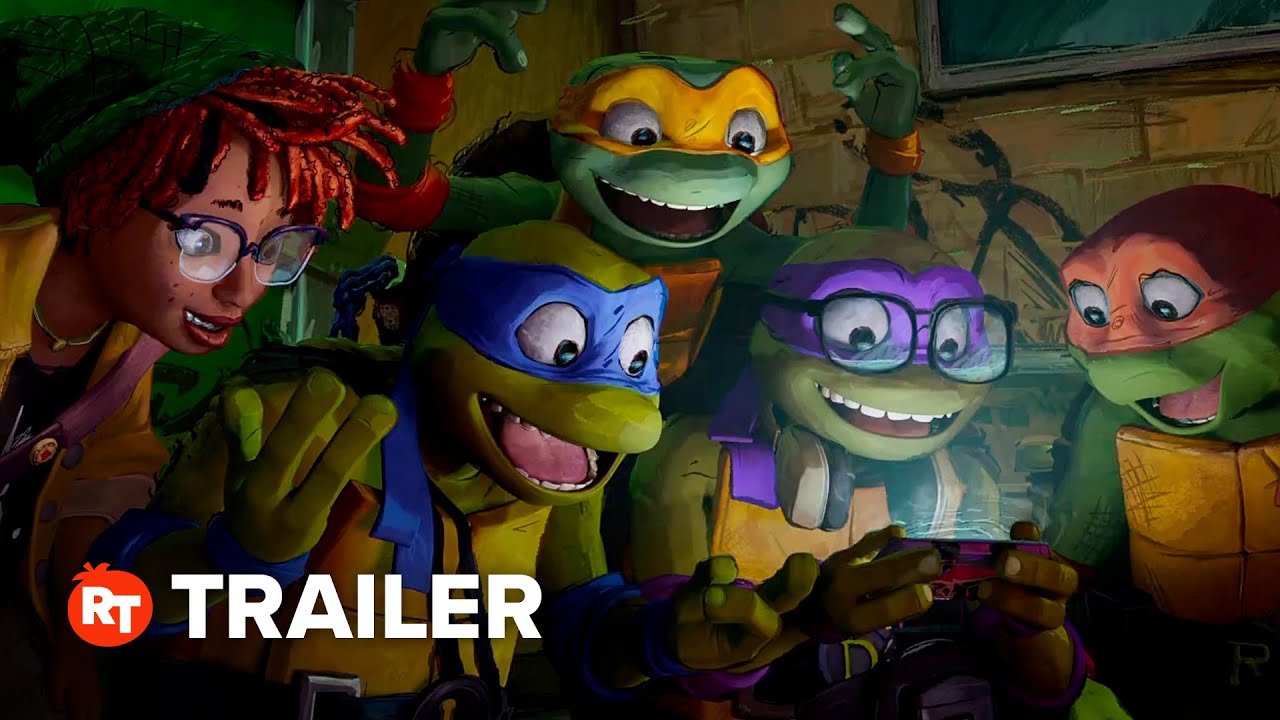
'Rise of the TMNT' in 2018 is the one I bounced off on sight, and the inconvenient part is that the show is good. The redesigns and the loud comedy-first style are not a failure of craft. It is some of the best-looking television animation of its era, sharply written, with a 2022 Netflix film dark and ambitious enough to convert a lot of the people who had sworn it off. My bounce had nothing to do with quality. I want freshness in the telling: the Turtles I know, in a story I haven't seen. 'Rise' reinvents the characters themselves, and that is the move that loses me. The Bay-produced films of 2014 and 2016 I will not defend, and nobody has asked me to. 'Mutant Mayhem' in 2023 nailed the sibling noise and the voice cast, then redesigned the Turtles into something you decode rather than recognise, which is the whole gap between good and great for me.
My own pitch is about to get tested in public, because the studio just went and made it. My instinct, held for years, was that what the Turtles needed was a big fun live-action film where they look and move like the version everyone remembers, no tweaks, paired with a Shredder story that finally works. That is close to the exact pivot Paramount announced at the end of 2025.
The grim version got shelved. An R-rated 'Last Ronin' film, with Ilya Naishuller of 'Nobody' circling the director's chair, was put back in the pizza box because the new Skydance-Paramount regime did not want the first non-animated Turtles film in a decade to be a bloody adult tragedy. Co-creator Kevin Eastman has since said he doesn't think it is off the table, which is the thing people say about projects that are, for now, off the table. What replaced it is my pitch wearing a producer's name. Neal H. Moritz, the man behind the Sonic films and Fast and Furious, is restarting the Turtles as a four-quadrant live-action franchise dated for November 2028, with the Sonic team in the building. The tell is that Sonic connection. Those are the people who, after the design backlash, went back and rebuilt the character to look like the version everyone pictured. "If you want Sonic, you go to the guy who did Sonic," one insider told The Hollywood Reporter, which is my no-tweaks requirement restated as a hiring decision.
My two impulses turn out to be in tension, and the studio resolved them the way I would have for the tentpole. The grim faithful-to-Ronin film is the casualty. The fun recognisable Shredder film is the plan. Whether they land the Shredder story is the open question, because no live-action film has, yet.
And in the background the franchise does the thing that always loses me, at scale. While the films get planned, Paramount is opening Turtles-themed pizzerias in Santa Monica, Monterrey and São Paulo, publishing an adult novel of 'The Last Ronin', and putting a preschool series called 'Teeny Mutant Ninja Turtles' onto YouTube. I had to read that last one twice. There is no version of the wish, the one I had at thirteen waiting for the suits to appear in a real alley, that gets granted by 'Teeny Mutant Ninja Turtles'. The machine isn't broken. It's working perfectly. That's both the problem and the point.
There is a word fans reach for when they watch this happen: protection. The Turtles, the argument goes, have not been protected. I used to make that argument. Then I noticed how few franchises ever have been, and that the ones held up as protected all share a shape. 'Calvin and Hobbes', which Bill Watterson guarded by refusing to sell a single plush toy. 'The Far Side'. Studio Ghibli. 'Mad Max', which George Miller protects by making one film a decade and then disappearing. Single-studio control, and a willingness to end the thing or leave long gaps rather than license it into a perpetual product engine. The protection is the scarcity. Once a property has to earn its keep every quarter, dilution stops being a risk and becomes the operating model.
The Turtles complicate that argument, because they were unprotected from the first issue. The comic was a parody of 'Daredevil' and Frank Miller's 'Ronin', of the whole grim-and-gritty Marvel mood of 1984, made by two broke young men who, the moment lightning struck, licensed it as hard as they could, because that is what you do when you have no money and a sudden hit. The 1987 cartoon turned a black-and-white indie satire into a toy brand inside three years. The dilution everyone mourns was not a later betrayal of the concept. It was the founding act. Eastman and Laird unprotected the Turtles themselves, gratefully, with both hands.
The reframe I keep landing on, against my younger self, is that protection might be the wrong lens for the Turtles entirely. Malleability is the concept. Batman has a fixed psychological core you can betray. The Turtles never had one. They were shapeshifters from the start, four blank parody-reptiles who became whatever each era needed: grim in Mirage, goofy on Saturday mornings, anime-shaped in 2003, indie again in 'The Last Ronin'. The chaos that looks like negligent stewardship is the honest expression of a thing that was never one thing. For someone who loves the fresh swing, that is no tragedy. A concept you can reinvent forever keeps throwing off new ones, which is the exact thing I keep turning up for. 'The Last Ronin' exists because nobody was protecting the Turtles from becoming something new.
The feeling was never only about the Turtles. It was about the wait. Spider-Man ran the same emotional structure on a longer fuse. Through the 1990s a faithful live-action Spider-Man felt close to technologically impossible. The rights sat in limbo, the James Cameron version never got made, and nobody was sure you could put a man swinging through Manhattan on a screen without it looking ridiculous. So when Sam Raimi's film landed in 2002 and the web-swinging simply worked, it hit the same childhood nerve the Turtles had: the thing you were told to stop hoping for, suddenly real and in front of you.
What the nostalgia is for was never the suits as craft, or the web-swing as engineering. It is for the version of me who wanted these things before he knew he would get them. The films were good. The magic was partly the years of wanting, loaded into the seat beside me. A studio can rebuild the suit to the stitch. It cannot rebuild the wait, or the boy who didn't know the wish would come true, and that is why the originals keep their glow long after later versions get technically better. They are carrying something that was never on the screen in the first place.
What I am doing this week, three decades into all of this, is reading five issues about the last turtle alive, and I will be done by Sunday. In November 2028 the man who made Sonic look right will put four reptiles in an alley again, and I will be in the cinema for it, the way I was at thirteen. The Henson suit is gone and the wait is gone with it. I will go anyway, and I will clap when Raphael loses the sai, and that will have to be enough. It usually is.