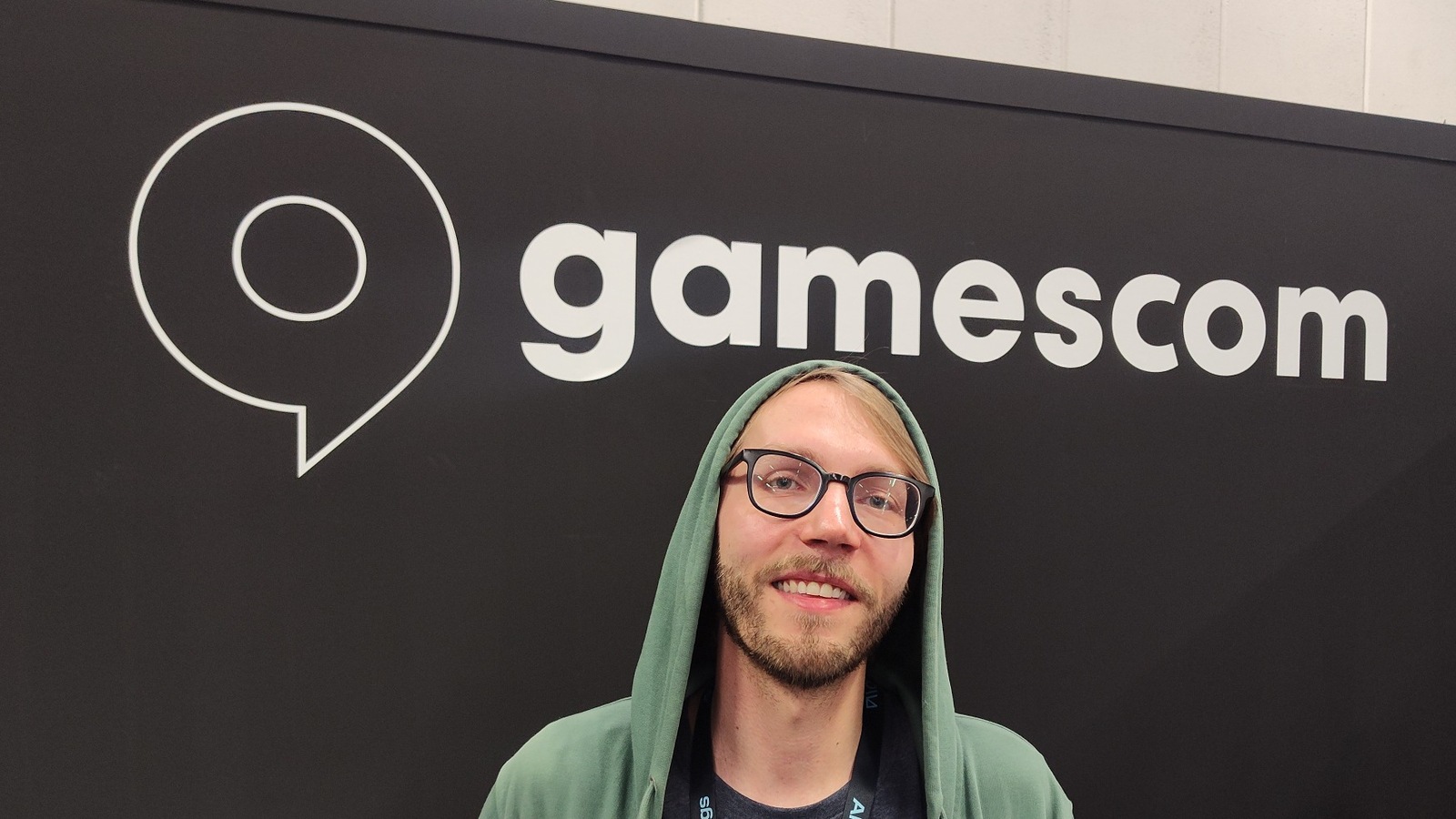
The vandal bothering your landlady is a crow. I learn this by arranging coloured fragments on a hexagonal board while Jussi Meriläinen watches from the other side of a borrowed Gamescom table. In ‘Fortune Fragments’, the player runs a shop in Clearcastle as a Foreteller, which means clients hand over soul stones and expect useful information about their futures. This first case looks like a neighbourhood nuisance. Build the right runes, reach the target and the reading opens far enough to reveal feathers. The crow turns up later as a customer, because even magical vandals eventually need professional advice.
Meriläinen is showing me the part of ‘Fortune Fragments’ that is difficult to put in a trailer. Dialogue leads into a puzzle; what happens on the puzzle board determines what you can learn, and that information changes what you can say afterwards. Later boards can even become harder because a character’s life has become harder. “We can show the inner turmoil,” he tells me. A visual novel can simply tell you that somebody is struggling. Runoi wanted the struggle to start interfering with the bit where you are trying to make the nice coloured pieces behave.

This would be an excellent moment for the game to demonstrate its systems flawlessly. Instead, the tutorial produces a bug. Meriläinen restarts the build, apologises once and explains that the tutorial has been the biggest pain of anything he personally implemented. The interesting part of that sentence is “personally implemented”. Meriläinen already knew games and creative work when Runoi started; he was not a programmer. In 2024, before the company could afford one, he began coding the prototype himself anyway. Once there was money, the studio hired experienced programmer Henri Huhtala. Meriläinen later told BusinessOulu that having somebody who specialised in programming gave the designers and artists more freedom. By then, he’d already got the prototype far enough to prove the idea worked. Getting to hire an actual programmer was one of the nicer things funding bought them.
Runoi began with three people bootstrapping and, by Gamescom, Meriläinen described it to me as a five-person studio with additional help around it. A private backer gave them enough footing to combine equity with a government grant; Business Finland’s Tempo funding later let the company work full-time. Concentrated development of ‘Fortune Fragments’ ran from spring 2025 to its 24 June 2026 release. That is a remarkably short route from prototype to finished game, although “finished game” is where Meriläinen’s account stops sounding like the version you put in a funding application. “We’ve had a rough launch,” he says. Marketing was difficult, and after June the studio was left with the considerably less magical task of figuring out where its audience actually was.
The people who did find it appear to like it. When I checked on 3 September, Steam listed 26 user reviews, 96 per cent positive. Runoi said a month after release that ‘Fortune Fragments’ had passed 5,000 wishlists, up from roughly 300 before Steam Next Fest. Nobody at the table starts shopping for yachts. Twenty-six reviews is a very small crowd. It is also enough to suggest that the immediate problem may be finding players rather than persuading the ones already there that the game is any good.
Meriläinen thinks some of that problem is built into what they made. “You can’t show five seconds or ten seconds,” he says during the demo. “You need to show the loop.” Gamescom is not naturally designed for this sort of patience. The halls are excellent for a game where pressing one button makes a building explode. ‘Fortune Fragments’ needs a client to explain their problem before the puzzle board can reveal anything about it. What you find there gives the conversation afterwards its weight. By the time the whole thing has introduced itself properly, a journalist has received two WhatsApps asking where he is and somebody nearby is already trying to reclaim the chair.
His favourite evidence that the design works comes from home. Meriläinen roughly divides players into story people and puzzle people. His fiancée belongs firmly to the latter group. “I don’t give a shit about your story,” is how he performs her original position. She then played ‘Fortune Fragments’ and became invested in the characters anyway. He understandably counts this as a win. I would be careful about building a market forecast from a sample of one, but as hostile user testing goes, sharing a home with the tester gives the feedback a certain urgency.
The game does have a clever way of making those two halves contaminate each other. Some puzzles hide information unless you build towards it, and later choices can affect a character’s ending. Meriläinen gives me a love triangle as the safe example: help one person and your advice can alter what happens later. There is also a substantially bigger political reveal that I am not going to spoil in an article about a game whose central occupation is extracting information people do not have yet. Early consequences are deliberately smaller. The tutorial first has to explain what a rune does before Runoi can reasonably ask you to interfere with someone’s romantic future.
Two months after release, the studio is still patching ‘Fortune Fragments’ and recovering from making it. Meriläinen came to Gamescom looking for localisers and for contacts that might help the game travel beyond its first Steam release. The team concentrated on one platform because there was not enough time to build everything at once, which is the sort of decision that sounds disappointingly sensible after you have just spent twenty minutes reading the future through glowing stones.
Our slot ends with the build running again and another appointment waiting somewhere in Hall 4.1. Meriläinen closes the laptop. Someone else needs the table.