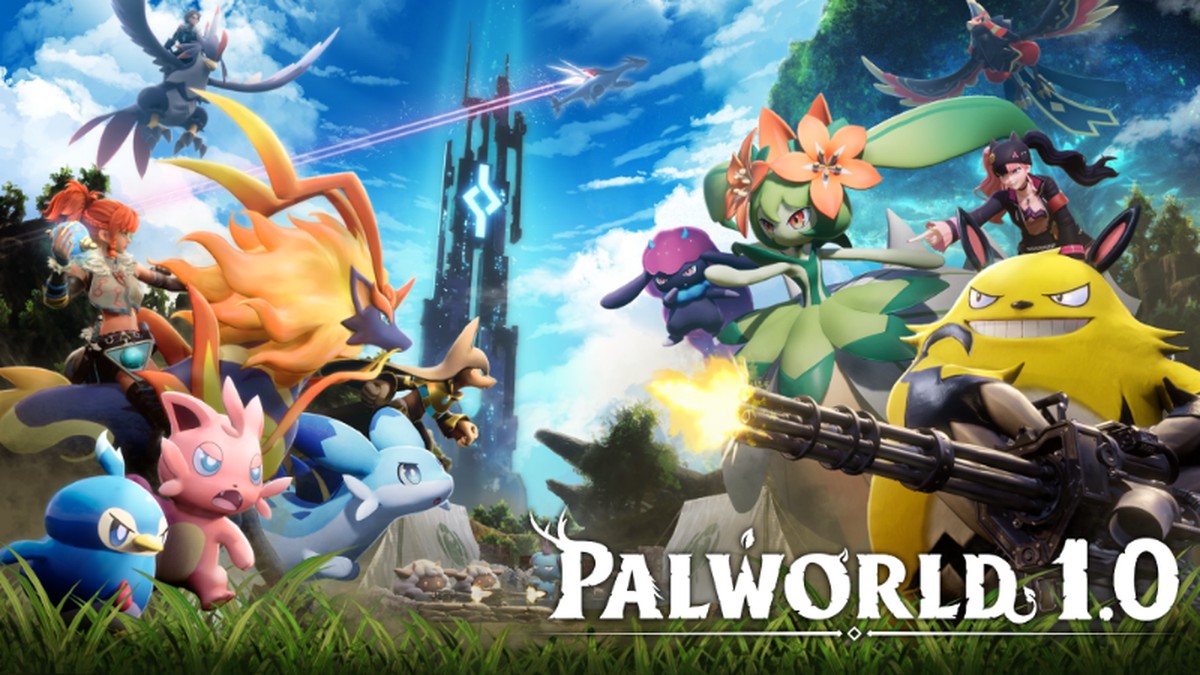
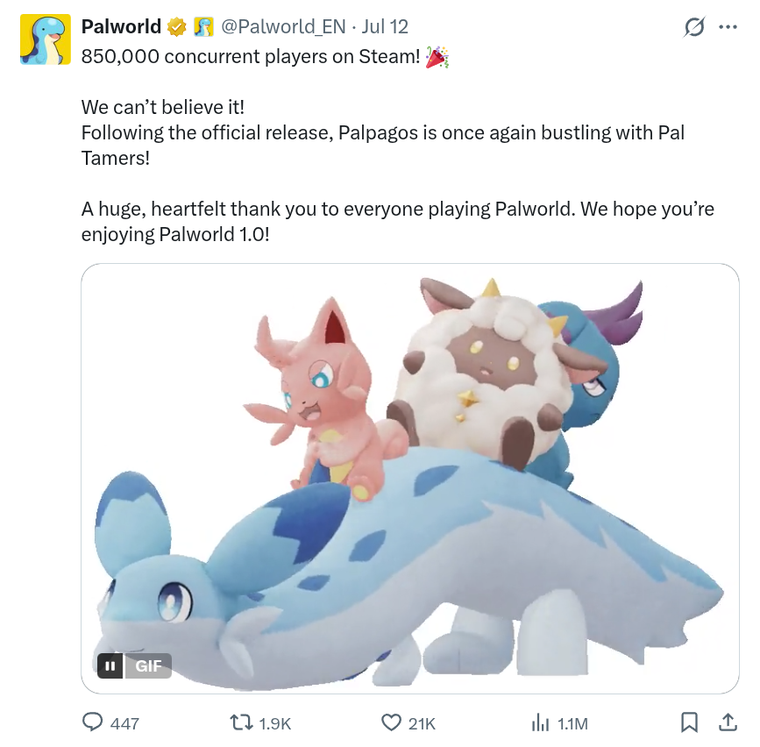
This week, 858,562 people were playing 'Palworld' at the same time on Steam, a remarkable number for any game and a spectacular one for a game that has spent twenty-two months being sued by Nintendo. The occasion was version 1.0, the graduation out of early access, and it did something no game had managed before, putting the same title into Steam’s all-time top 15 twice. The first time was the launch in January 2024, when 2.1 million people turned up at once and set a record that still ranks third in Steam’s history. This was the encore, and encores are not supposed to be this loud.
The update earns the fuss. It finally opens the World Tree, the landmark that sat sealed behind a red barrier on the horizon for two and a half years, and it lands with 72 new Pals and an actual story, the patch notes running so long that Steam struggled to print them. Pocketpair could have used the graduation to raise the price, the way any sensible company would, and left it at $30 instead, $21 for the moment, a restraint that in 2026 counts as performance art. The figure that tells the real story is the small one underneath. On a normal night the game had been drawing around 35,000 players, the settled pension of a two-year-old hit, and the weekend multiplied that crowd more than twenty-four times.
All of it happened while the game was being sued, and that is the part worth slowing down for. Nintendo and The Pokémon Company took Pocketpair to court in Tokyo in September 2024, over three patents covering how creatures get caught and ridden, and the whole internet, me included, filed the story under Goliath finally coming for the studio behind 'Pokémon with guns'. I gave Pocketpair six months. Nearly two years on the crater is right where everyone predicted, only it sits on the wrong lawn.
Nintendo’s ask was the first surprise. It wanted five million yen for itself and five million more for The Pokémon Company, about $66,000 with interest, roughly the sticker price of a mid-range company car. The figure reads like a typo until you understand how Japanese patent law works, where the money is a formality and the injunction is the weapon, and the aim was to make Pocketpair change the game or pull it from sale in Japan. Pocketpair did change the game, after its own fashion, turning the move where you glide hanging from a Pal into a plain glider item and reworking how Pals come out of their spheres, then calling the whole exercise 'disappointing' while shipping it anyway, months before any judge could have ordered it.
And then Nintendo’s own patents started failing their inspections, which is not a sentence anyone expected to write about Nintendo. In October 2025 Japan’s patent office knocked back a related application for lacking originality, pointing to prior art in 'ARK' and 'Monster Hunter 4' before arriving, with what I can only assume was a straight face, at 'Craftopia', an earlier game made by the company Nintendo was suing. Five months later an American examiner threw out all 26 claims of the US summoning patent as obvious, leaning partly on Nintendo’s own older filings, which leaves Nintendo’s patents in the odd position of being beaten by Nintendo’s patents.
Florian Mueller, the German analyst tracking the case at games fray, now puts Nintendo’s odds against the current game at zero and estimates a realistic payout at five million yen, about $30,000, a figure he cheerfully files under 'chump change'. Nintendo’s latest annual report separately logged around $40 million under 'loss on litigation'. It does not say how much, if any, belongs to this case. The funny comparison I wanted is not in the filing, so it does not get to be in the sentence.
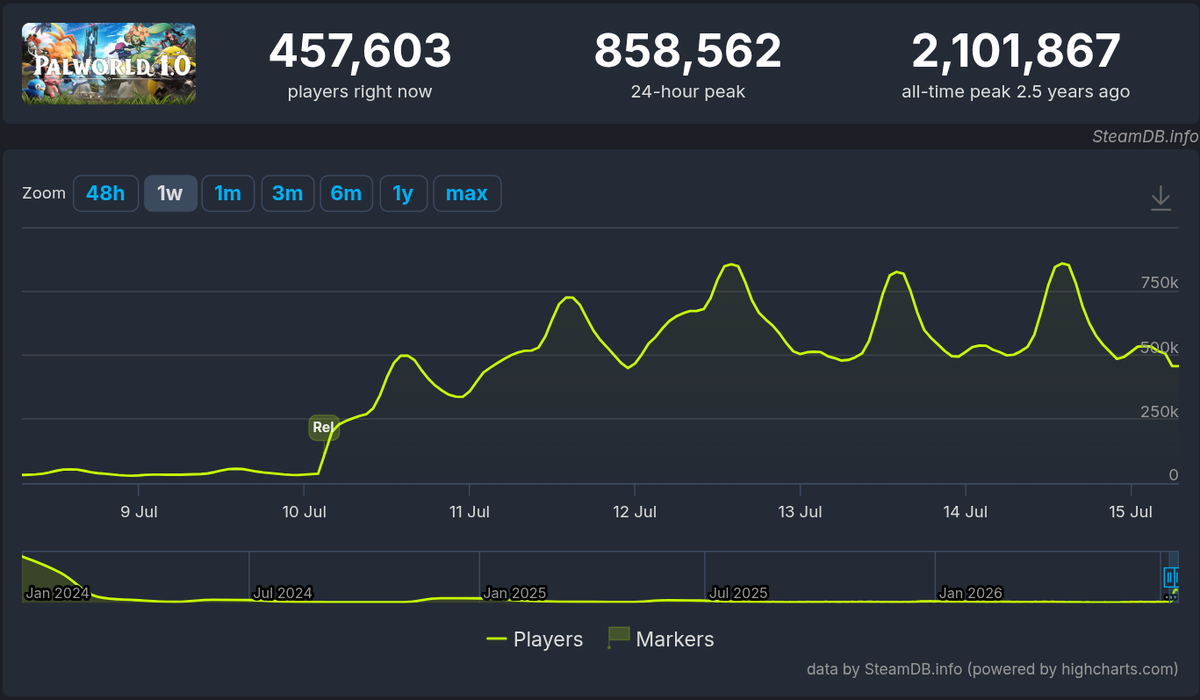
What is left of the suit has been narrowed to cover only old builds of 'Palworld', versions nobody can buy anymore, which gives the whole thing the flavour of suing a ghost. There is a hearing on 1 October and a ruling a few weeks after, and nothing decided in that room can lay a finger on the game 858,562 people were happily playing this week.
Campaigns like this get fought to set an example, and this one has come out backwards. What 'Palworld' proves to every developer sitting on a monster-catching idea is that surviving the most feared legal department in entertainment costs about two animations and buys you the biggest second launch Steam has ever seen. Pocketpair has even taken to doing Nintendo’s brand protection unpaid, redrawing several Pals in 1.0 to look less like Pokémon, which is the courtroom equivalent of winning a fight and then straightening your opponent’s tie on the way out.
John Buckley, the studio’s head of communications, summed the weekend up as ‘obviously, we had high expectations for 1.0 internally, but this is staggering’, the sound corporate delight makes when it is trying to stay humble. The plan from here runs to a dating-sim mode and, landing this month, a 'Palworld' trading card game, a product category The Pokémon Company might have a thought or two about.
The ruling comes on 9 November. Should Nintendo win everything still left to win, the money works out to roughly three and a half cents for every person who was inside 'Palworld' when it peaked this week. Nintendo should keep the cheque under glass, the way Scrooge McDuck keeps his Number One Dime.