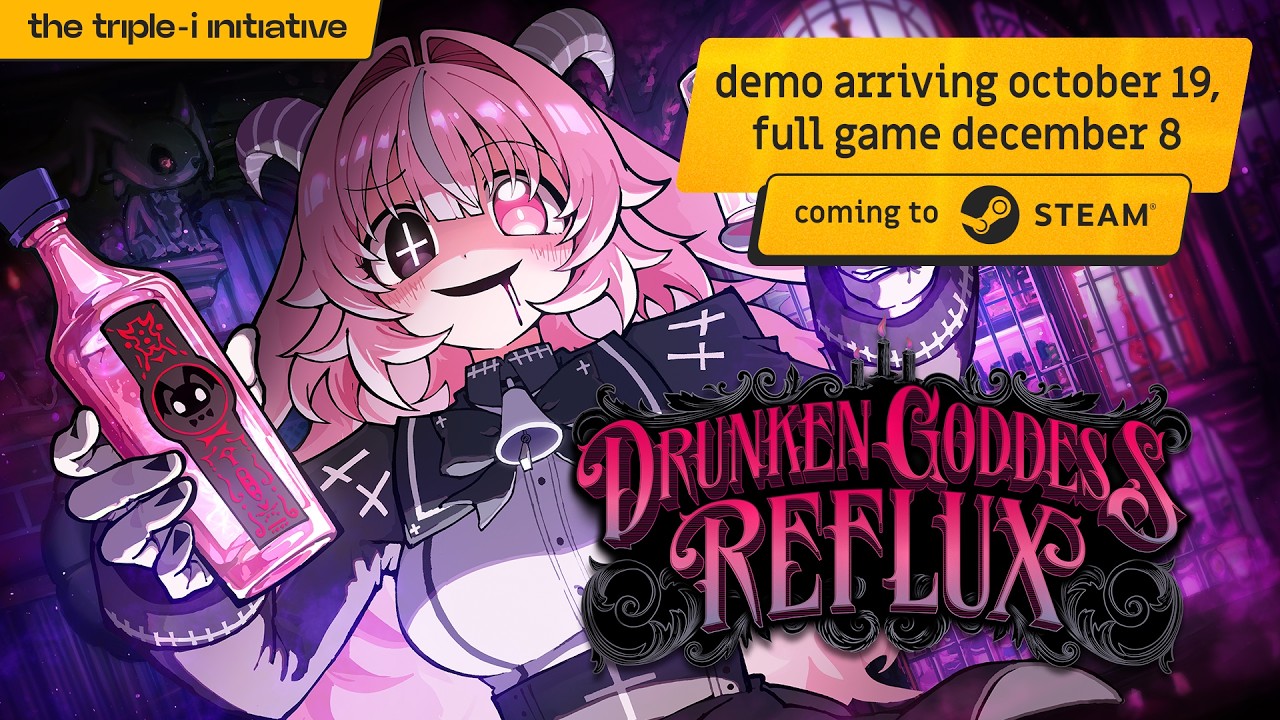
Alliance Arts has cancelled today’s public demo of ‘Drunken Goddess Reflux’, a single-player game involving Russian-roulette-style drinking games against a demon, citing fears of rapid imitation using AI or other tools. Selected players will still get to meet the demon in a closed test, provided they agree not to let an AI study the encounter.
The publisher’s 16 October cancellation announcement gave two reasons. It cited difficulties controlling the publication and streaming of gameplay footage, alongside concern that other developers could imitate the game’s presentation or mechanics and release competing work before its launch.
No actual copycat has been established by that announcement. Nor does it demonstrate that AI could reproduce the game from a demo, or that cancelling public access will prevent imitation. What Alliance Arts has done is replace an open invitation with a smaller group whose members must accept detailed conditions.
The official Steam description identifies the demon as Femme Soule, lovesick and in Hell’s Pandemonium bar. The player’s goal is to get her drunk enough to spill her soul. A game about loosening someone else’s tongue now requires prospective players to consider what they may disclose afterwards.
The closed-playtest notice sets an application deadline of 22 October at 11.59pm Japan time. Testing is scheduled for 23–31 October, with exact session times subject to further announcement or change. Participants will be chosen by lottery.
Applicants must be at least 15, have a suitable PC and join the official Discord, the game’s community on the chat platform. They must also agree to the participation rules, and minors need parental or guardian consent. Meeting those requirements gets someone into the draw, rather than guaranteeing a place.
The participation agreement prohibits sharing playtest gameplay videos and disclosing spoilers outside the authorised Discord arrangements. Creating or distributing copies is prohibited. It also bans using playtest material for AI training and using AI to analyse the game, and includes restrictions concerning the creation of imitative works before launch.
The AI provisions go further than asking participants not to feed material into a training dataset. They also rule out using AI to examine the game. Someone applying simply because a demon drinking contest sounds entertaining is being asked to accept rules written partly for someone with a rather different project in mind.
For an ordinary participant, the immediate consequence is easier to grasp: playing does not come with permission to publish a gameplay video. Spoiler discussion has an authorised setting. The test can still gather responses, but the agreement limits how the experience travels beyond the selected group.
There is a release date behind this effort to control access. An 8 December 2026 PC launch was announced on 8 October, as Gematsu reported. The Steam listing nevertheless displayed no announced date when researched. That discrepancy does not erase the October announcement: the publisher is trying to protect the approach to a specified December launch.
The Steam listing names Alliance Arts and WHO YOU as developers, with Alliance Arts also publishing. A competitor would not necessarily need to reproduce their entire game to worry them. Something recognisably similar could compete for attention while the original was still awaiting release, even if it lacked much of the finished work.
That is a plausible commercial concern, not evidence that it will happen here. It also needs separating from copyright. Imitating a general gameplay mechanic is not necessarily infringement; reproducing protected artwork or code raises different questions. Participation conditions do not make every possible resemblance unlawful, and their existence cannot guarantee that nobody will copy anything.
The footage concern explains why this decision reaches beyond the downloadable software. A video lets people inspect a game without playing it. The same recording that helps a prospective customer understand the appeal could also serve as reference material for someone contemplating an imitation. Alliance Arts wants to restrict that second use without relinquishing every opportunity for people to try the game.
What gets squeezed is the casual encounter. A public demo can accommodate someone who has just seen the title and wants to find out whether it deserves ten minutes. Applying through a community and waiting for a lottery result asks for a little commitment before the game has had a chance to earn it.
For ‘Drunken Goddess Reflux’, the distinction between looking interesting and being interesting to play is particularly worth preserving. A drinking contest against a demon is an efficient way to secure a glance. Whether the decisions remain enjoyable after the novelty wears off is something prospective players could have investigated through the public demo. A description cannot do that work for them.
Alliance Arts is not starting from obscurity. The October release announcement reported more than 500,000 Steam wishlists, meaning users had saved the game on the PC shop to follow or consider buying it. That is an announcement-reported figure, not a live, independently verified count or half a million promised sales.
It does complicate the assumption that the publisher must welcome every opportunity for exposure. With substantial interest already reported, it might judge another public demonstration less valuable than keeping more of the game under control until December. The wishlist figure provides context for that possibility; it does not establish how Alliance Arts calculated the decision.
Closed testing still offers a way to discover what players struggle with or enjoy. Its volunteers will, however, have selected themselves for a process that requires joining the community and accepting its conditions. The person who might have downloaded a demo on a whim is easier to lose along the way.
There is no measured commercial verdict yet, and this individual cancellation establishes no industry-wide retreat from demos. The immediate loss is smaller and more familiar than that: an enthusiastic tester may want to show a friend the bit that won them over. Under the gameplay-video ban, they will have to make the recommendation without the clip.