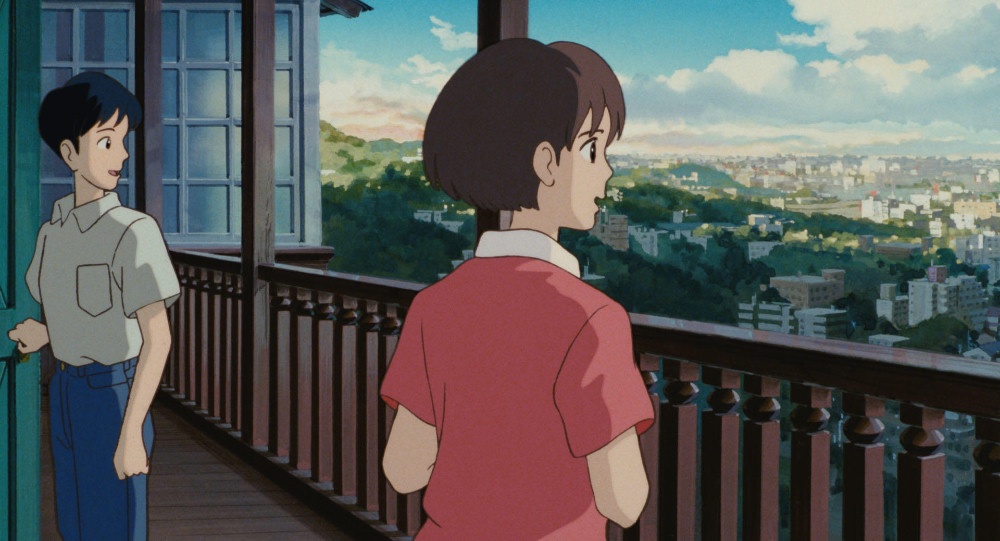
When Shizuku Tsukishima runs up the stairs to the school roof in ‘Whisper of the Heart’, her skirt catches the wind. Studio Ghibli cinematographer Atsushi Okui still remembered that movement more than thirty years later.
Earlier this year, while talking about director Yoshifumi Kondō, Okui used the shot as an example of how closely Kondō watched people. A girl running upstairs was worth getting right. So was the fabric around her knees. Kondō had spent years doing this kind of work on other people’s films before Studio Ghibli finally gave him one of his own to direct.
Today that film returns to cinemas in a new 4K restoration.
Hayao Miyazaki’s name is all over ‘Whisper of the Heart’, and for good reason. He adapted the manga it is based on, wrote the screenplay and drew the storyboards. But Kondō directed the film. Once you know that, some of its smallest choices start looking less accidental.
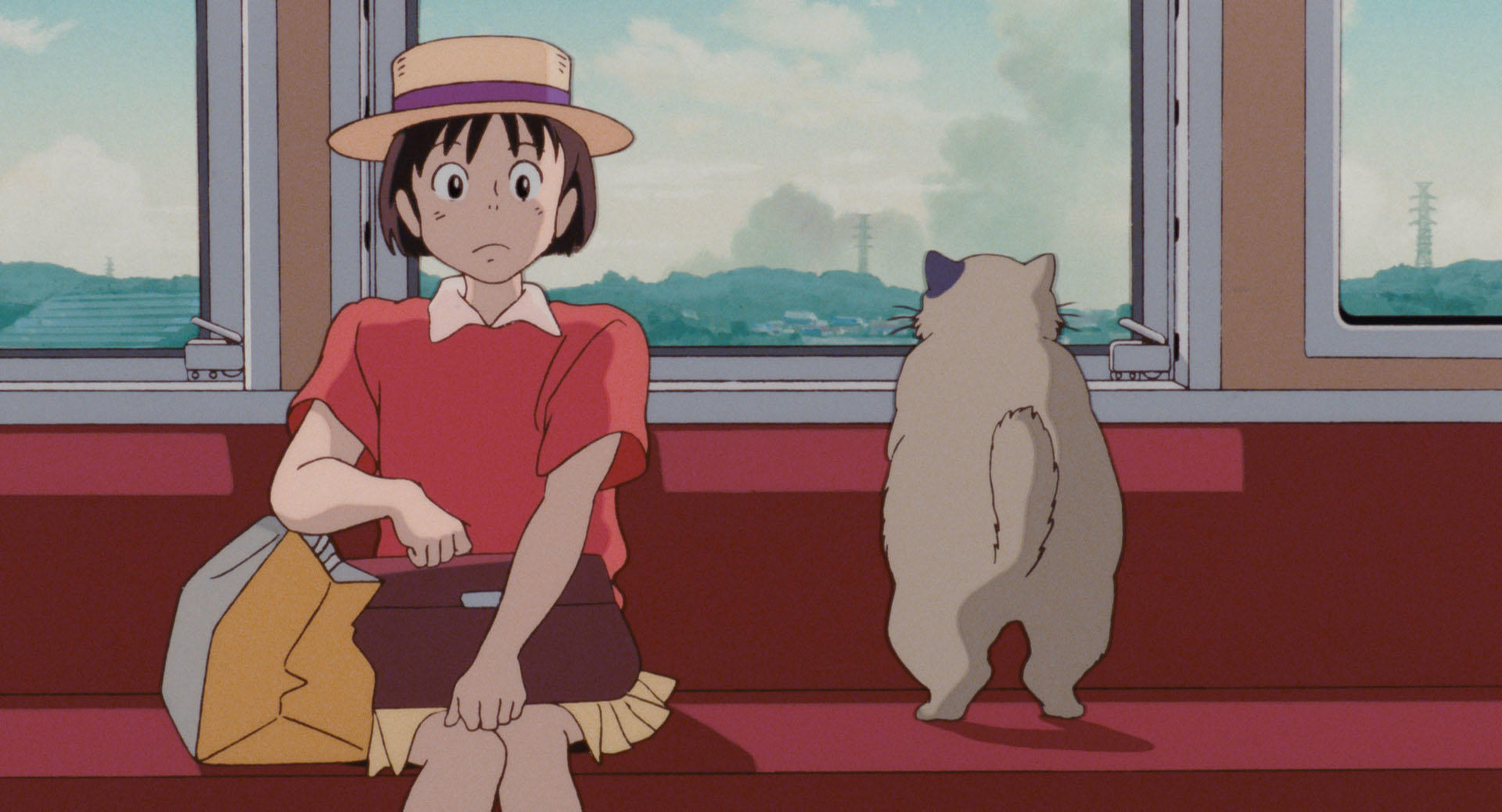
A fat cat rides a commuter train alone near the beginning.
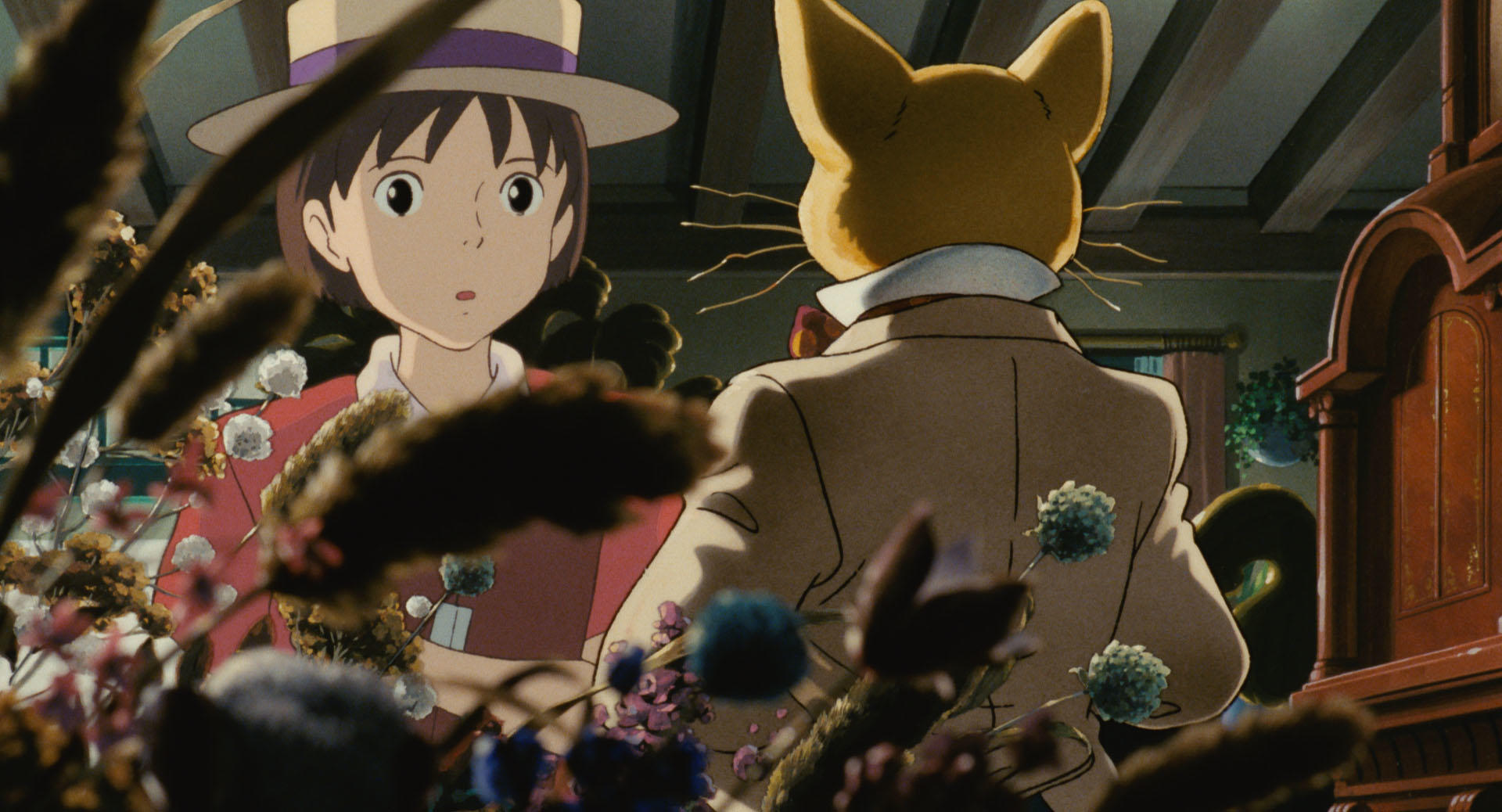
Shizuku notices it sitting several seats away with the calm of somebody who has done this commute before. When it gets off, she follows. The cat leads her through the neighbourhood and towards an antique shop, where the story begins nudging her into the orbit of Seiji Amasawa.
Seiji is fourteen and has already decided he wants to make violins in Cremona, Italy, where he plans to train as a craftsman. This is an alarming amount of career planning for somebody who should still occasionally forget his PE kit.
Shizuku, who loves books and has already noticed Seiji’s name appearing on library cards before hers, starts asking herself what she might be able to make. She chooses a novel.
The movie lets that go badly enough to feel true. Shizuku stays awake too late, neglects school and eventually produces something she knows does not match what she imagined. An older man she trusts reads it and encourages her without pretending the first draft is actually brilliant.
Useful criticism in a film about writing. Almost science fiction.
‘Whisper of the Heart’ is very good about the unpleasant stage between liking good things and being capable of making one yourself. Shizuku has taste before she has the skill to satisfy it. Seiji appears to have accepted that improvement requires years of work, which naturally makes him more attractive and more irritating at the same time.
Kondō keeps most of their story grounded in the Tokyo around them. Family members squeeze past each other in a small apartment. Trains are full of people going somewhere. Hills remain hills.
For one sequence, Shizuku’s unfinished novel takes over and the film flies into a vast fantasy landscape. Okui says Miyazaki directed that part himself. You can feel the picture briefly leave the pavement before Kondō brings it home again.
The crew went to absurd lengths to make that ordinary world convincing. Okui filmed a train leaving Higashi-Koganei Station because he wanted to study how quickly the view outside should begin to move. For the sunrise near the end, members of the team climbed a steel tower around five in the morning with video equipment and waited for Tokyo to brighten.
Nobody finishes the movie thinking about the accuracy of train acceleration; the motion simply feels right.

That makes the new restoration unusually delicate work.
Older animation has sometimes survived the trip into high resolution only to emerge looking as if somebody cleaned it with industrial detergent. Grain disappears. Colours become louder than they ever were in a cinema. Painted backgrounds suddenly look determined to justify the price of the television.
Ghibli has taken a careful approach.
Okui says the studio had already scanned much of its film library in 4K for preservation years ago. When the restoration team returned to those scans, they were trying to reproduce the colour of the finished film as audiences originally saw it, rather than the brighter colours of the painted cels before photography changed them.
That is magnificently nerdy work, and it suits this particular movie. ‘Whisper of the Heart’ needs evening light that looks a little dim. Shizuku’s neighbourhood should still feel lived in. The train windows do not require an upgrade.
Kondō had spent much of his career as an animator and animation director before ‘Whisper of the Heart’. He worked on ‘Kiki’s Delivery Service’ and ‘Only Yesterday’, two of Ghibli’s earlier films, and later contributed to ‘Princess Mononoke’. People inside the studio expected him to direct again.
He died in 1998, three years after ‘Whisper of the Heart’. He was 47.
Knowing that can make the movie feel sadder than it actually plays. It is a warm, funny film about a girl discovering that wanting to make something and knowing how to make it are separated by an inconvenient amount of work. There is a love story, a family that gets on each other’s nerves and a cat that seems perfectly capable of using public transport without assistance.
The film found its audience long ago; many of those viewers never learned Kondō’s name.
The restoration puts his work back on cinema screens today. Shizuku runs upstairs, the wind catches her skirt, and for a second nothing important happens.
Kondō thought it was worth getting right.