On the sixteenth of May, 1983, Michael Jackson travelled backwards while moving forwards, and forty-seven million people felt the floor of reality flex a little, and then spent forty years talking about the footwork so they'd never have to talk about the flex.
(Forty-seven million is the number cited for that broadcast. I don’t know if anyone has ever checked it. Also, they taped ‘Motown 25’ back in March. Television used to make you wait for your miracles, even in the US. This will matter later.)
Hold this image right there. We're coming back for it. First, let me tell you about the day a machine took my job:
March, a Monday. The email had a calendar invite attached, which is how I knew, and I remember I was out of chocolate milk (I don’t drink coffee, not even in Sweden, because it is bitter and nasty and of the devil) and my dog still had to go out and pee when the meeting was already over. The company was pivoting to AI. I understood this, and my manager who politely gave me another reason, something something “not enough assets”, understood it too. My replacement doesn't need sleep. It doesn't need to pay the rent or battle a chocolate milk addiction. It has a temperature setting. Not the same thing as a soul, though on a deadline you can barely tell the difference.
There is a side effect, though, and no warning signs. Once something that doesn't exist has taken your chair, you develop a sixth sense. You know the shape of cut corners. You smell them everywhere.
Even in physics.
Let’s talk about the small stuff first: Déjà vu, which many people just call a brain hiccup, and which behaves exactly like a cache serving you a page that it already had. Or dreams. Try to read a page of text in a dream, or to check a clock twice. It can’t be done, the numbers and letters will rearrange, because text rendering got cut from the dream build. Someone, at some point, made a budget decision about your subconscious, and they never told you.
And now for the big one, printed in every physics textbook on Earth, and we all just live with it: the universe does not fully commit to the state of matter until something looks. Until observed, particles keep their options open. Physicists call this the measurement problem and get cross if you call it anything else, but physicists also can't agree on what a measurement is, so we're even. In games, there's a name for a system that only renders what the player is currently looking at. Performance optimization. Game producers do it when they’re out of money.
So the universe is cutting corners, got it. Next question then, and it should be an obvious one:
Who cut the budget?
I followed the money. Turns out the trail is old.
The Gnostics filed the first formal complaint, about two thousand years back: creation is real, management is absent, and middle management is actively hostile. They were declared heretics for it, which is what happens to whistleblowers to this day. I feel like the Gnostics issued the first ever Glassdoor review, a reference that didn’t work before Glassdoor was a thing. The point is the pattern, and the pattern is everywhere once you start looking. Read any mythology cold, without the incense. Gods retire or die, delegate, go quiet, sail west, stop returning prayers. Ragnarök, read properly, is a handover document.
Tolkien understood this better than anybody before or since, which is why he ended his great story not with a battle but with a resignation letter. The Elves get on ships. The senior developers, the ones who'd been there since before the lighting worked, sail into the west and leave the players the keys. And he left exactly one being behind that he refused, his whole life, to explain.
Tom Bombadil.
Countless scholars have gone to war over what Bombadil is. Let me end it free of charge: he’s legacy code. He predates the current build. He obeys none of its physics. The Ring, the game's central mechanic, does nothing of consequence to him at all, and nobody removes him because nobody knows what breaks if he goes.
Every developer reading this just thought of a Bombadil. By name. Every one of them knows one personally. Some of them are the Bombadil, and those ones know it.
Now the part that isn't funny.
If you want to know what it feels like when a world actually ends, skip Revelation. Read the notice Ubisoft posted when it switched off ‘The Crew’. An entire drivable United States, every fake sunrise over its fake Rockies, deleted, and the people who lived there scattered with nothing but screenshots. That was the 31st of March, 2024. Look it up, it has a date, like a death does. ‘Concord’ got a meagre two weeks. Universes are dying younger than fruit flies now.
And listen to the vocabulary, because nobody says delete. They say sunset, which might be the tenderest word ever applied to an execution. Mine they called a pivot. Pivot, sunset, restructure, right-size: capital keeps inventing dance terminology for the act of switching worlds off, and then the machines get the blame. I want to be precise here, because that’s the only way to stick it to the overlords: The machines are not taking your job. The people who own the machines are taking your job and letting the machines take the fall. A language model has never made a decision in its life. Decisions are made by men with equity, and equity always renders in full detail.
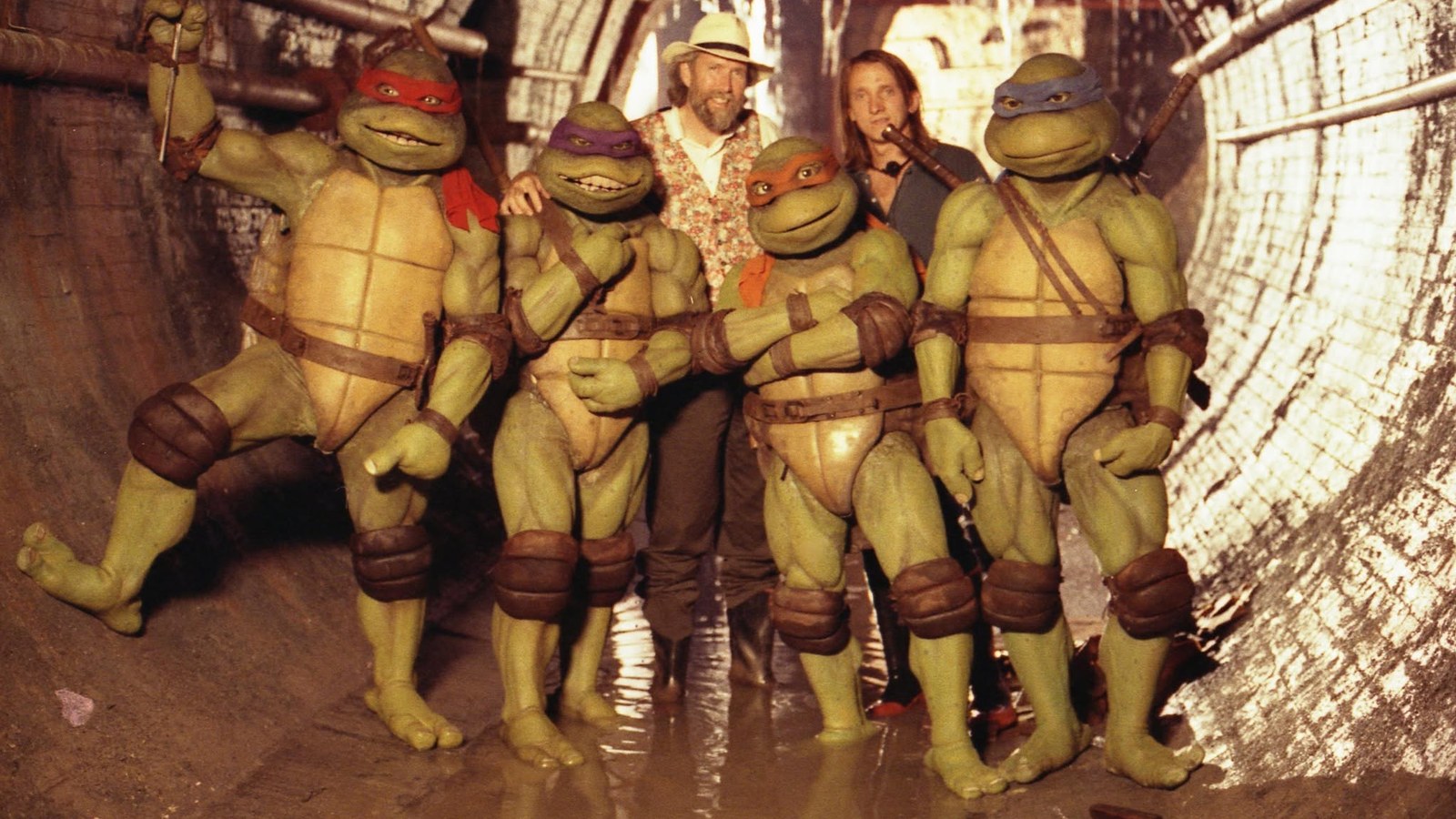
There's a Ninja Turtles comic, stay with me here, it is the saddest object in American popular culture, called ‘The Last Ronin’. One turtle survives. He carries all four weapons on his back. Katana, bo, sai, nunchaku. His dead brothers' whole arsenal, strapped on, forever, heavy.
That's surviving a layoff round. You file your stories and theirs. You carry the weapons.
This is the point in the essay where I'm expected to reassure you.
I'd rather make it weirder, which is the way I operate. It turns reassuring by accident, I promise. Accidental is the only kind of reassurance I've ever trusted.
The forecasters, the serious ones, with their spreadsheets accompanied by a low ongoing hum of terror, have been timing the machines for years. The stopwatch keeps saying the same thing: The length of task a machine can hold in its head doubles roughly every seven months. Seven-ish. So an hour of coherent machine work became a day. A day is turning into a week. And everyone extrapolates the curve out three years and starts arguing about their jobs, which, fair, I did too, out loud, alone in my bathroom.
Cowards, though. All of us. Draw the curve all the way out.
A mind that holds one task for a year. For a century. Keep going, it’s fine. A mind that can hold a single task for thirteen billion years without once checking its phone.
We have a word for the output of a mind like that.
You're standing in it.
This is what everyone gets wrong about the simulation argument, and why it's become the most boring faux-deep conversation at every party. The question always is whether any of the world is real. Rain on your face is real, go stand in some, I'll wait. The interesting question is a labor dispute:
Who's still on staff?
Look at the evidence again. Corners cut, “not enough assets”. Laziness repurposed as a law of nature. Legacy code standing in a forest singing nonsense, ho Tom Bombadillo, holding up who knows what. A canceled universe goes dark, R.I.P. ‘The Crew’, and this one's lights are still on. Flickering, but on. What we're living in is an understaffed universe with its skeleton crew. Original team long gone, sailed west, and we’re not welcome in Valinor.
Meanwhile, the universe only renders where someone is looking.
You already see where this is going: Lookers are staff.
Consciousness is a gig. You were hired at birth, no interview, which explains a lot about the onboarding. Every time you actually look at something, not scroll past it, look at it properly, you are holding one small region of the universe at full resolution, on shift. The feed prices your attention like inventory; upstairs it's booked as payroll.
Every X-Men comic is secretly about this. People who wake up one day rendering more than everyone around them. Mutants pull more compute, run hotter, hold whole rooms at a resolution nobody asked them for. And get feared for exactly that. Hunted and registered. The system does not love a worker who draws that much power. I've read hundreds of these comics. Staffing documents, all of them.
My dog dreams. Legs going, nose working, chasing something across a field that exists nowhere except the private build behind her eyes, and some department of this understaffed cosmos looked at that render request and approved the compute anyway. Gwen has never once doubted the world is worth looking at. This is why dogs were never laid off. Permanent staff since the Ice Age. She holds the whole field at full resolution, joy included, and has never in her life had a note for management.
My mother tongue has a word I think about constantly. German has a word for everything, it's the language's whole business model. Feierabend: the sacred moment work ends and you get to be a person again. The universe has not had a Feierabend in thirteen billion years, somebody has to keep the lights on. This somebody turns out to be you. I mean, who else is still in the building?
Sweden, where I live now, once made me wait two weeks for proof of my own existence. No provisional document, nothing to hold. The Swedish state does not do provisional documents. You exist or you don't, now please take a number. I stood outside the tax office in the cold thinking of how even here, existence is a processing queue. Even here, somebody has to stamp you real. So I stamp back now. That's the whole job description, you walk around stamping things real.
I thought of a strategy, and I offer it free of charge, which tells you what kind of decade journalism is having:
Look at things until they get embarrassed and become more real. Take in streetlights. Look at faces on the train. Appreciate the specific gold of ten p.m. July light on a pine suburb, which can't be photographed (I've tried). Soak up all that’s priceless, there’s plenty. Buy the books that matter in print. I own X-Men omnibuses and fantasy novels the size of paving stones, because when the servers go down, and they will go down, print doesn't. Read old books out loud with friends. A reading group is a raid party, and the boss is meaninglessness, with an enormous health bar. Go where sixty thousand strangers scream the same chorus at the same second, like the Foo Fighters concert I was just at. It's the largest render farm your city permits. Learn one dead man's dance move well enough to teach it to the next generation. Be polite to dogs without exception. You're addressing senior staff, after all.
And when a man with equity tells you the future unfortunately requires switching your world off (this is the political part), tattoo it somewhere visible: make him say delete. Make him use the real word. In front of everyone.
Sunset is for skies.
Back to 1983, then. Forty-seven million witnesses, give or take, and a man travelling backwards while moving forwards.
Nobody on that stage was dancing. It was a field demonstration of an exploit. The renderer lets you move in two directions at once if you commit hard enough. Forwards, into a future that is mostly cancellations. Backwards, towards everything you're still carrying. And if you commit, commit completely, forty-seven million people feel the floor flex and spend the next forty years calling it entertainment.
By the way, that’s grief. The moonwalk is grief with better shoes. Forward-facing, backward-moving, impossibly smooth, and the crowd loses its mind because every single one of them recognizes it and not one of them can name it. It’s all in the subconscious. He taped it in March and the world saw it in May, and I think about that too. Even the miracle sat in a queue.
You've read this far, which means for the last nine or ten minutes you've been rendering me, a stranger, a laid-off man in a pine suburb with a dreaming dog and a chocolate milk addiction, at full resolution. And I've been rendering you. Whoever you are. Whatever shift you're keeping. Between us we held a small corridor of the universe open, end to end, and nothing came unplugged on our watch. Between the two of us, there were enough assets.
That's the entire job. The pay is nothing, the hours are all of them, and the work never stops being the point. People deploy that sentence right before asking you to work for free. I checked anyway, this time it's true.
Now go look at something like it owes you money.
It does.
— Ben, Popkulturist