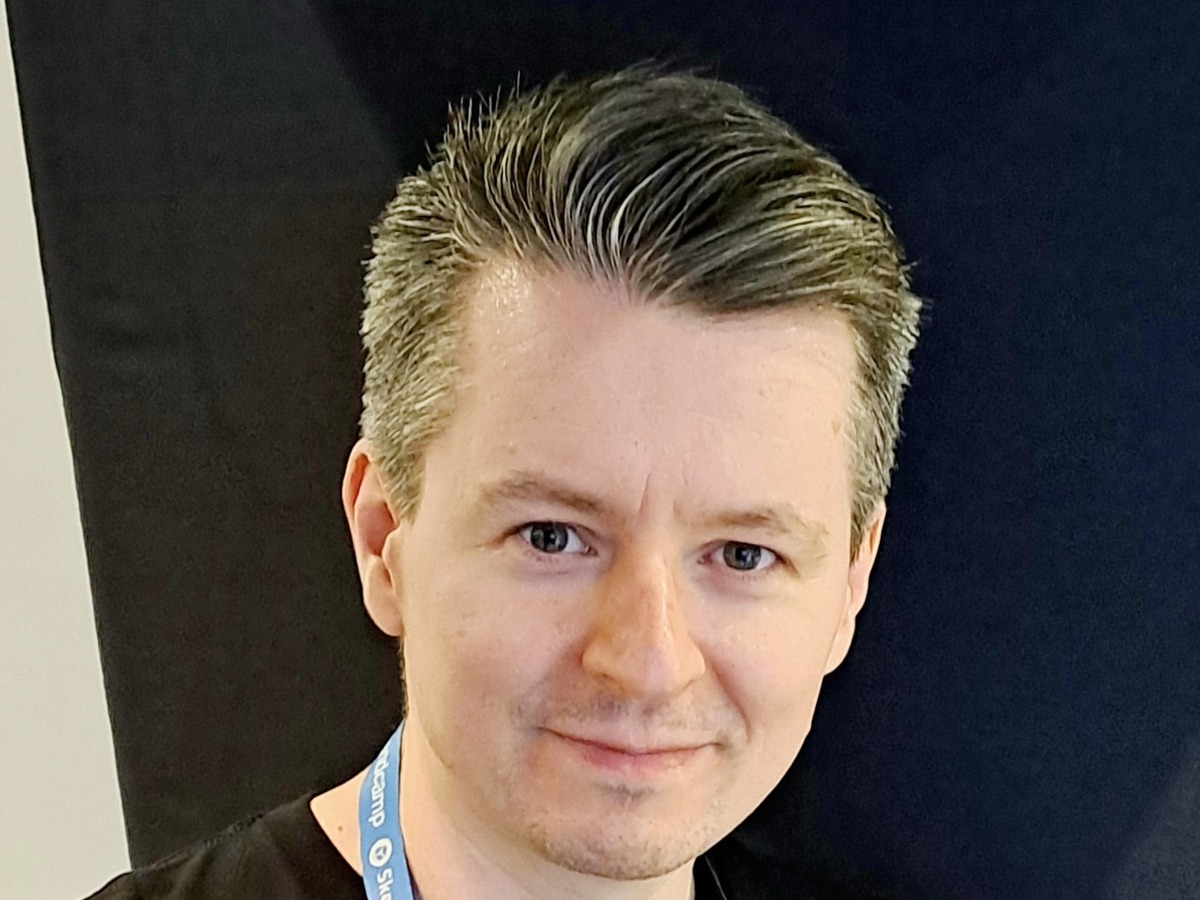
At 4 p.m. on Tuesday, Dick Stanley sends me directions: “I am in the smokers corner next to the entrance.”
At Gamescom, this leaves some room for interpretation. We find each other eventually. Dick Stanley has just become head of a new studio whose name, at that point, he cannot tell me. I ask what problem he is building it to solve.
“Joblessness.”
There are longer answers in our conversation. None improve on that one. I ask how much of the company already exists, from staffing and financing through to clients.
“All of that.”
He asks me to hold the piece until after XDS, the Vancouver conference devoted to external development. The name I can finally use is Evoc8, a brand of STAND 8, with Will Baxter as co-founder. STAND 8 already has delivery operations in several countries, so the infrastructure behind the pitch is larger than a new logo and a Gamescom meeting.
GDC’s 2026 industry survey found that 28 per cent of respondents had been laid off during the previous two years. Among respondents in the United States, it was 33 per cent. I arrived in Cologne with another odd pair of numbers from Germany: the country had 4 per cent more games companies than a year earlier, but 3 per cent fewer employees.
Dick Stanley thinks those figures belong to the same change. Studios are trying to stop carrying their maximum production needs as permanent payroll. His own description is less polite.
“At any given time, when someone starts a studio, it’s just a countdown to a layoff,” he says. “There’s no studio that hasn’t done that.”
He had already made the argument publicly in July, in a LinkedIn essay with ‘Pirate Booty’ and ‘walking the plank’ in the title. When he shared the piece, Dick Stanley apologised in advance for the heavy pirate metaphors. He was right to. Underneath them is the point he gives me in Cologne: a full-time job can look permanent while the business supporting it remains tied to one product cycle.
Evoc8 is being built for co-development. It will not own the games it works on. Dick Stanley expects studio management and some research work to sit inside the company, while production capacity can expand through contractors and partner studios as projects require it.
I ask whether that makes Evoc8 a permanent team or a company assembling people around individual jobs.
“It’s both.”
That answer contains the difficult part of the plan. External work is hardly famous for security, and Dick Stanley expects Evoc8 to rely on plenty of contractors while it gets established. His longer-term idea is to separate the place that finds the work from the place that gives people a durable employment home.
He describes a partner organisation that would eventually provide healthcare benefits and retraining, with an ambition to move it towards non-profit status within a year or two. Evoc8 and other partners would bring projects into it. Workers could then remain attached to the organisation when one client’s project ended instead of beginning another job search from zero.
That infrastructure does not exist at full scale yet. Dick Stanley says the early Evoc8 workforce will include many contractors, with some strategic permanent roles likely to come first as the workload grows. He singles out producers, people who know how to get projects over the line and can move between them.
He also wants to take some of the sales burden away from smaller studios doing co-development while trying to make their own game. Dick Stanley says he has repeatedly seen studios take client work because they need the money, then discover that the game they actually wanted to make never gets finished.
“90% of the time, the game never gets completed,” he says of that split model. It is his estimate rather than an industry statistic. The business response is concrete: Evoc8’s wider organisation has salespeople, and Dick Stanley wants them finding the work and managing the calendar so a partner studio spends less of its own time wondering what happens after the current contract.
If it works, workers get a better chance at continuity while smaller studios get a steadier pipeline. Evoc8 only has a business if enough large studios trust it with the work.
External development often enters a game when somebody discovers a hole. A deadline is getting close or a feature is behind. Sometimes the team simply needs more hands than it has. Dick Stanley wants the call while the budget is still being built.
“When the plan starts, when you’re looking at the budget, let us get involved,” he says. He wants studios modelling outside capacity months ahead, rather than treating co-development as something to buy once the problem is already visible.
The word he keeps coming back to is trust. A large studio has to tell an outside partner enough about what it expects to need for that partner to keep people available. Without that visibility, Evoc8 inherits the same boom-and-bust problem it is supposed to soften, only one step further down the chain.
The model can still fail for a boring reason: somebody has to buy enough work. Dick Stanley can spread risk across clients and use STAND 8’s sales operation to find projects, but a quiet quarter is a quiet quarter. Continuity only means something if it survives one.
When I ask what would have to be true twelve months from now for him to call Evoc8 durable, he does not give me a headcount. He talks about maintaining the relationships he already has and getting large studios to bring co-development partners into production earlier.
I ask what numbers he expects to be able to share. Financing, he says. Hiring plans too, although the hiring will follow the workload.
“Plans will depend on what the load is.”
A launch announcement promising a hundred new jobs would be easier to write. Dick Stanley does not give me one, which may be the most sensible thing anybody building a studio in 2026 can do.
A year from now, I want one number from him: how many people finished a project on Friday and still had somewhere to work on Monday.