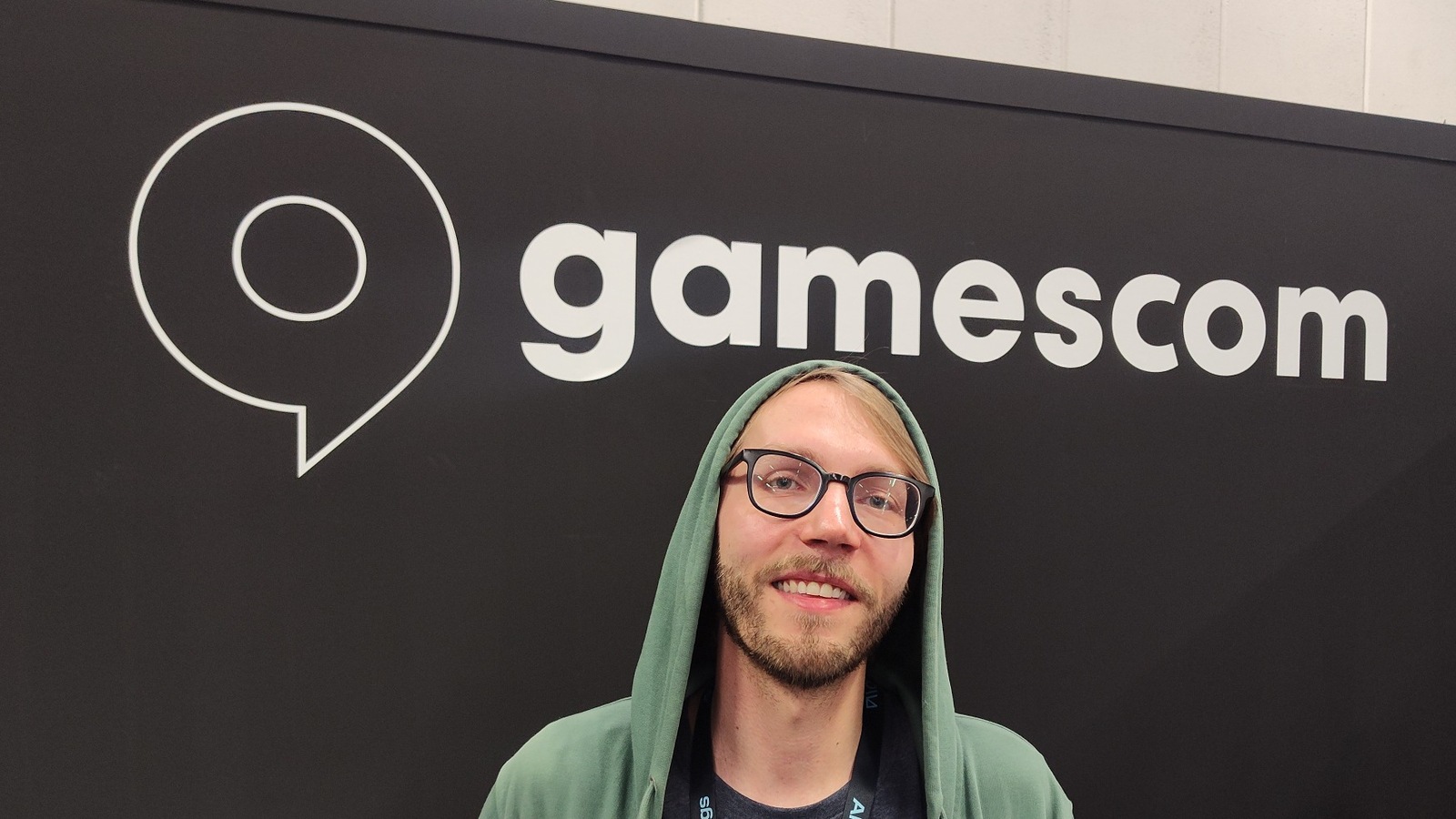
On Tuesday at Gamescom, Tommy Thompson is already talking about Friday.
“I’m looking forward to falling asleep somewhere in the middle of Friday afternoon on my way back home,” he tells me.
He has another talk in about twenty minutes. When he reaches the stage, he will describe himself as fuelled by coffee and “a little bit of existential anger”. Thompson has worked in game AI for twenty years and runs AI and Games. The technology has finally become fashionable enough to ruin his schedule.
I ask where AI is actually landing in games in 2026. His first answer is a correction to the premise. Games did not discover artificial intelligence when ChatGPT arrived. Studios have used it for years in cheat detection and player analytics, alongside the systems that make characters behave like they have plans.
Generative AI changed who gets to touch the machinery. A developer who once needed to build a Python workflow can now hand a spreadsheet to Claude and ask questions in English. Code generation has moved from experiment to a serious production conversation in larger studios. The people being asked to think about AI are no longer just the people who were already thinking about AI.
He brings up a survey of Japanese online-game studios that reported 100 per cent AI use. One common application was behavioural analysis. Thompson’s response was essentially: yes, of course. Games have been using machine learning for that kind of work for about twenty years. The newer story is that large language models can make the analysis accessible without every studio building the same specialist tooling from scratch.
The management question has changed too. Thompson says he hears large studios tell teams to “show us how AI can help in your workload”. The wording already assumes that a useful answer exists.
“That puts a lot of stress on developers,” he says.
His preferred approach is less flattering to the people buying the licences. Teach teams enough to understand what the tools can and cannot do, then accept the possibility that they come back and say, “This is useless to us.” The people making the game know more about the work than the executive asking for an AI use case.
He has equally little patience for the opposite sales pitch. Much of the AI industry, he says, turns up with some version of “AI is going to be great for you, buddy”. If the response from the person doing the job is “go fuck yourself”, Thompson considers that understandable.
One thing he refuses to do is arrive at a studio and explain the developers’ own jobs back to them. “It’s incredibly arrogant of me,” he says. He knows AI. They know how their game actually gets made.
At 13:45, my leading question has become a PowerPoint.
Thompson’s talk is called ‘Five Mistakes Studios Make When Embracing AI’. Governance comes first, followed by literacy. From there he gets into data, the gap between written procedures and actual work, and the numbers companies use to decide whether an experiment succeeded.
He begins by asking the room who has an AI policy. The response is thin.
“Holy crap, this is one of the lowest scores I’ve seen in years,” he says.
On stage, his minimum viable policy is a Post-it that says no. When we spoke twenty minutes earlier, he had used the fuller version: write “fuck no” in giant letters and stick it somewhere people can point at.
This may be the cheapest governance framework at Gamescom.
He means it. An indie studio can hate generative AI and still need rules for it. Refusing the technology does not prevent somebody inside the company from opening Claude Code, Gemini or whatever arrived in a software update that morning.
He tells me about studios where the art team wanted no part of generative AI and the narrative side agreed. Meanwhile, programmers had started using Claude Code. Management had avoided the argument by never writing down where the boundary was.
During the talk, Thompson turns that tension into a hypothetical anyone in the room can picture. Imagine a studio programmer is away at Gamescom. Back at the office, an artist hits a shader bug and asks Gemini for a few lines of code. The code appears to work, so it goes into the project. Then Thompson flips the situation: imagine the programmer notices missing subtitle dialogue and asks GPT to fill it in instead of handing the problem to the narrative team.
In each case, a general-purpose tool makes it easy for one discipline to step into another person’s work without the usual handoff or review. Nobody at the studio has decided where generated material is allowed to cross that line, so the decision gets made by whoever happens to have the prompt box open.
“Programmers are very cranky at the best of times,” Thompson tells the room. The narrative team, he suggests, may also have thoughts.
European studios have another reason to stop pretending this can remain informal. Thompson points to AI-literacy obligations under the EU AI Act. His broader point is simpler than the legislation: if a tool can affect the work, the people using it need enough understanding to argue about it properly.
I ask what the press gets wrong about AI in games. Thompson doesn’t really blame the press. He says the industry makes the subject hard to report: studios keep their actual use cases behind closed doors, and even after twenty years in the field he still struggles to keep up. Some of what he knows comes from engineers telling him things at events that their employers never publish.
A headline saying everyone is using AI can therefore be true and still tell you almost nothing. Thompson wants the questions that come after it: what kind of AI, where it sits in production, who uses it, and whether the player ever sees the result.
Thompson says Western AAA studios have moved more cautiously on generative AI than many mobile and live-service developers in Asia. He is also explicit about his own line. Player-facing generated art and animation sit outside his values, and he includes voice work in that argument.
The talk gets much better when Thompson leaves policy and starts talking about how work actually happens.
A company tells him that a process has five steps. Once somebody watches people do the job, there are twenty-seven. One of those steps contains another 101 smaller steps. The sequence changes depending on who is doing it.
Nobody lied about the five steps. They just left out the part everybody does without thinking.
People know that if one system fails you click a different button, wait, ask somebody in another team and carry on. Nobody writes all of that down because everybody already knows it. Then an automation project arrives and tries to reproduce the tidy version.
The result can be expensive theatre. Thompson has seen studios get a task running faster while making communication harder or forcing teams to rebuild a process around an external model. For live-service teams shipping on a two-week cadence, that dependency becomes dangerous if the model changes or access disappears. A price increase can wreck the calculation too.
Then Thompson gets to the number every executive wants to see: 25 per cent faster. On paper, the pilot is a success. The developers, meanwhile, hate the new workflow. The company has saved time and made the job worse. Excel is having a much better day than the people using the thing.
Thompson says studios need both the quantitative result and the qualitative one. A time saving that only appears once does not tell you much. A repeatable saving can still be a bad trade if the people doing the work hate the new process or the product suffers.
During the Q&A, an indie developer asks the question sitting underneath the whole presentation: how many studios know the baseline before they start measuring the AI pilot?
Thompson says larger production teams often have a decent grasp of delivery rates and deadlines, but even then the useful metric may take time to find. He describes one studio that ran several pilots before it understood what it should measure. Once the team put the numbers beside the developers’ experience, one experiment reached a conclusion that rarely appears in an AI keynote:
“This isn’t worth it.”
They kept the old workflow. Thompson seems perfectly happy with that.